
Prepare what you expect to see, keep checking it against the terrain and know when observation must lead the way.
You reach a path junction and immediately know which way to turn. The decision was made before you arrived. A few controls later, a vague hillside does not match your expectation, so you slow down, observe its shape and establish your position before continuing.
Both moments involve useful map reading. The difference is where the process begins. Proactive reading starts from a prepared plan; reactive reading starts from what you are observing now. A dependable orienteer needs both, used for the right reason.
Prepare the decision before reaching it
Proactive navigation means selecting the information that will organise the leg: the route, the important references, the control approach and the first direction. You then use the terrain to confirm that the plan is unfolding as expected.
This does not require studying every detail before moving. A short, obvious leg may need very little deliberation. A long leg through unfamiliar terrain may need more. The useful standard is whether you have a sufficiently clear plan to execute the task.
If the next decision can be prepared safely while the current leg is under control, use that opportunity. If it cannot, take the time where it is needed. Running out of a control on an uncertain direction can make a later route choice harder to correct.

Make anticipation concrete
Imagine a leg to a boulder beyond a broad spur. A useful plan might identify the spur shoulder as a major reference, a distinct path bend as the last reliable point and a precise bearing into the boulder. You also understand whether the final approach rises or falls.
Now the terrain has a purpose: recognise the shoulder, confirm the bend and check the slope during the attack. “Stay focused” has been translated into actions you can carry out and review.
The details should fit the map and the athlete. An experienced runner may recognise the structure quickly because similar decisions have been practised in that terrain. An unfamiliar forest creates more uncertainty about runnability, visibility and how features are represented. That is a reason to prepare specifically, not to force faster decisions without a basis for them.
Select the route, key references and approach before committing.
Know which terrain features should appear and in what order.
Match those expectations to the actual ground as you move.
If evidence contradicts the plan, establish position and adapt deliberately.
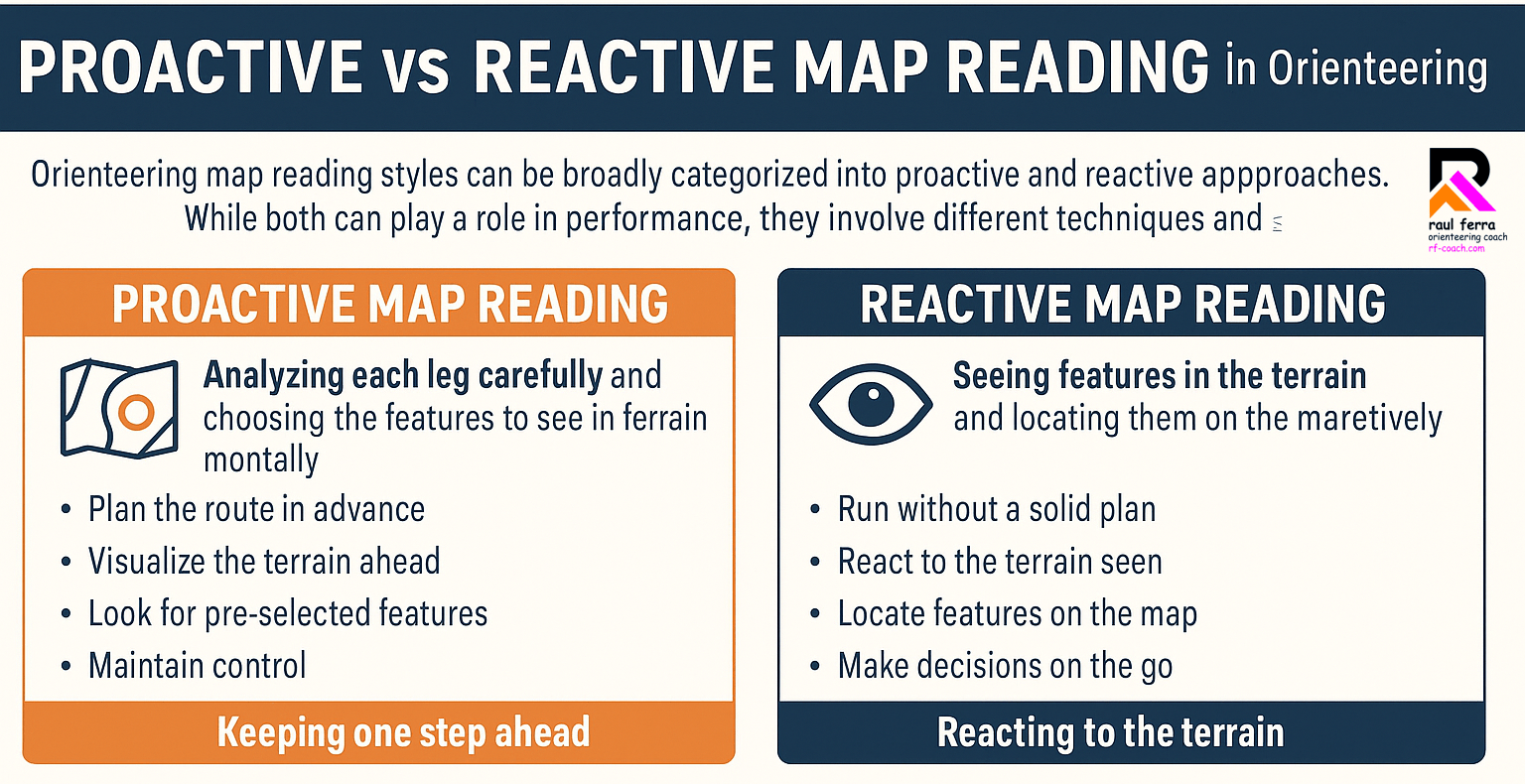
Reactive reading has an important role
Observation must lead when your position is uncertain. You orient the map, inspect the terrain and identify a combination of features that establishes where you are. You may also need to adapt to an obstruction, an unexpected vegetation boundary or a feature that is less visible than anticipated.
That is different from repeatedly arriving at decisions with no plan. A runner who reacts well to new evidence can remain in control. A runner who is constantly surprised by the next junction or control approach is repeatedly paying for late preparation.
Mass starts and relays increase social pressure, but they do not remove the need for an independent plan. Another runner can provide information; their confidence is not proof that their route is yours.
Avoid the trap of confirming only what you expect
An anticipated picture can be wrong. If you decide too early that a knoll is the expected feature, you may interpret everything afterwards around that assumption. Keep checking relationships: direction, height, distance travelled and the arrangement of neighbouring features.
A mismatch is a signal to clarify, not an inconvenience to ignore. On the other hand, maps generalise. Learning which discrepancies matter is part of terrain experience. The aim is a plan that can respond to evidence.

Train the timing of decisions
| Exercise | Main task | What to review |
|---|---|---|
| Stop and plan at easy speed | State the route, final reference and exit direction before moving | Was the plan complete enough to execute? |
| Selected-feature navigation | Choose a small number of reliable references | Did they organise the leg, or did simplification remove necessary information? |
| Partner shadowing | Execute independently while a partner observes | Where was reading early, late or disconnected from a decision? |
| Race-intensity intervals | Maintain the routine while running harder | Which part changed when speed increased? |
Begin with a manageable task. Gradually reduce external prompts and test the routine on a new course. Knowing the answer from a repeated map can make execution look more independent than it is.
Review one decision in detail
After a session, choose a moment that felt fluent and one that felt rushed. When did you first understand the problem? When did you choose? What confirmed the route? This distinguishes a planning issue from an execution issue.
The distinction between proactive and reactive reading is a practical coaching tool. It does not imply a fixed percentage of time saved or a guaranteed reduction in errors. Its value is that it helps you identify why a leg felt controlled and what to practise when it did not.