
How terrain experience, honest analysis and practice at race speed make better decisions feel natural.
Open a course from a forest you have never visited. Hide the GPS tracks and try to choose your routes. Across that marsh, or around it? Is the white forest really fast? Does the small path justify the extra distance? You understand the symbols, yet you keep changing your mind.
Now reveal the runners’ tracks. Several take a line you barely considered. They stay on slightly higher ground, cross the marsh at a different point and use a short section of path before attacking the control. Suddenly, you begin to see possibilities that were missing a minute ago. The map has not changed. Your interpretation has.
You have already started learning about the terrain without leaving home. You still do not know whether those routes were best, or whether they would suit you, but you have better questions to take into the forest. That is where useful preparation begins.
The aim is to reach race day with enough relevant experience that many choices no longer require this prolonged debate. You recognise a promising line, understand what will make it work and commit. That feeling of “this is the way” is something we can train.
The path to trained intuition
Learn the terrain → Compare decisions
Practise at speed → Test on new legs.
What trained intuition actually means
Trained intuition means recognising a situation quickly and drawing on experience to make a useful decision.
In orienteering, that experience connects what the map shows, what the ground allows and what you can execute. Knowing the symbols is only the beginning.
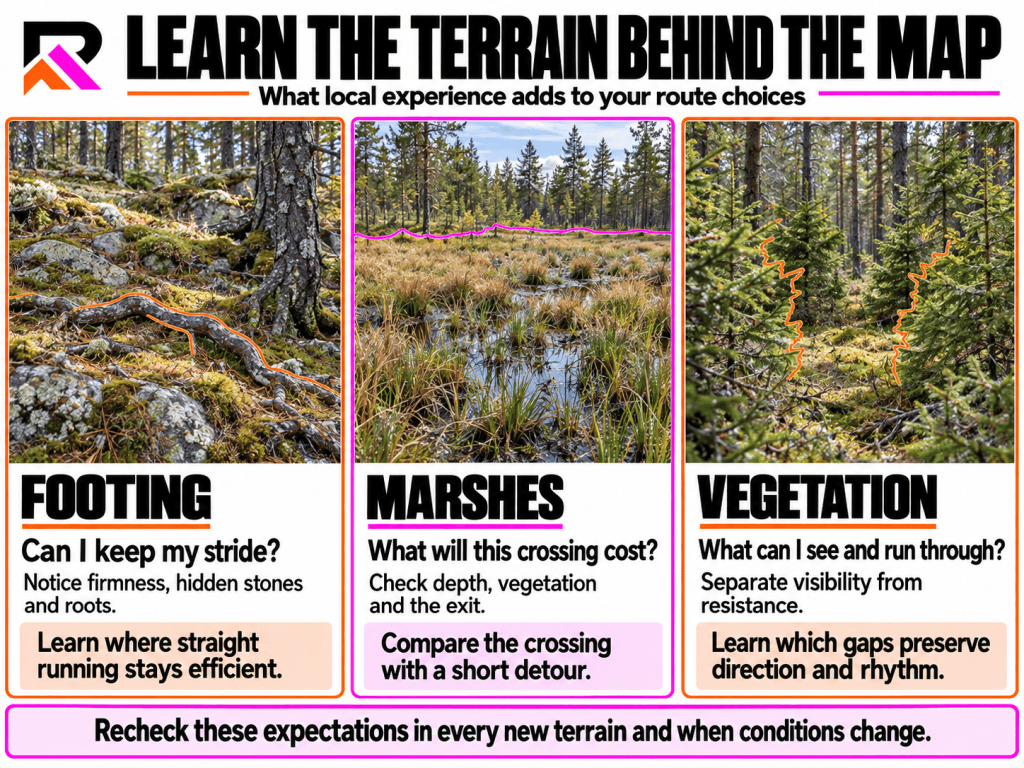
A patch of open forest might have firm soil, soft moss, hidden stones or low vegetation that catches every stride. Marshes differ in firmness, depth, vegetation and the difficulty of getting out on the other side. A light-green area may reduce visibility more than running speed; elsewhere it may break your rhythm completely. The map describes important differences, but you need local experience to judge what they mean for your movement.
This knowledge shapes far more than the big left-or-right choice on a long leg. Within your chosen route, you make hundreds of smaller adjustments: pass above the wet hollow, use the gap between two patches of vegetation, stay close to the line here, accept a short detour there. With practice, many of these decisions happen without a detailed conversation in your head.
Trying to compare every possible option through a long, conscious calculation would be far too slow. Preparation helps you narrow the problem. You recognise the useful information sooner, discard unlikely options and spend your attention on the uncertainty that actually matters. A major route choice can still require deliberate thought. Experience makes that thought better informed.
A 2024 study by Guo and colleagues compared 40 expert and novice orienteers in a recognition task using real-world scenes. Experts responded faster and more accurately, with more efficient visual search. This supports the connection between expertise and how athletes pick up information, although the comparison does not prove which training method caused the advantage.[1]
New terrain, new assumptions
International orienteering keeps moving. From one season to the next, the major events take athletes to different countries and often very different terrains. The basic skills travel with you. Your expectations about the forest need adjusting. A habit that saves time at home can become an expensive mistake elsewhere.
Our Kuopio analysis with Thierry Gueorgiou highlighted how small, stony or root-covered paths may offer little advantage over the surrounding forest. In Loch Ard, vegetation and highly variable marshes created a different set of questions. “Take the path” or “stay straight” cannot be carried from one terrain to another without checking the assumptions behind them.
For serious international performance, specific preparation is a must. It allows you to adjust your judgement to the championship you are preparing for. General technical ability remains essential, but it does not tell you how this particular ground will feel at speed, which features will stand out or which small deviations will pay off.
This is also why confidence alone is a poor guide. Kahneman and Klein’s work on intuitive expertise explains that reliable intuition depends on opportunities to learn meaningful patterns in an environment; feeling certain does not guarantee being right.[2] For an orienteer, that means finding out where previous experience applies, and where it needs updating.
Start at home: predict before you watch
Return to that unfamiliar course. Choose a few legs that ask different questions: a marsh crossing, a slope, a vegetation transition, a long route choice.
- Draw your intended line before seeing anyone else’s.
- Explain your choice in one sentence.
- Name one uncertainty to investigate.
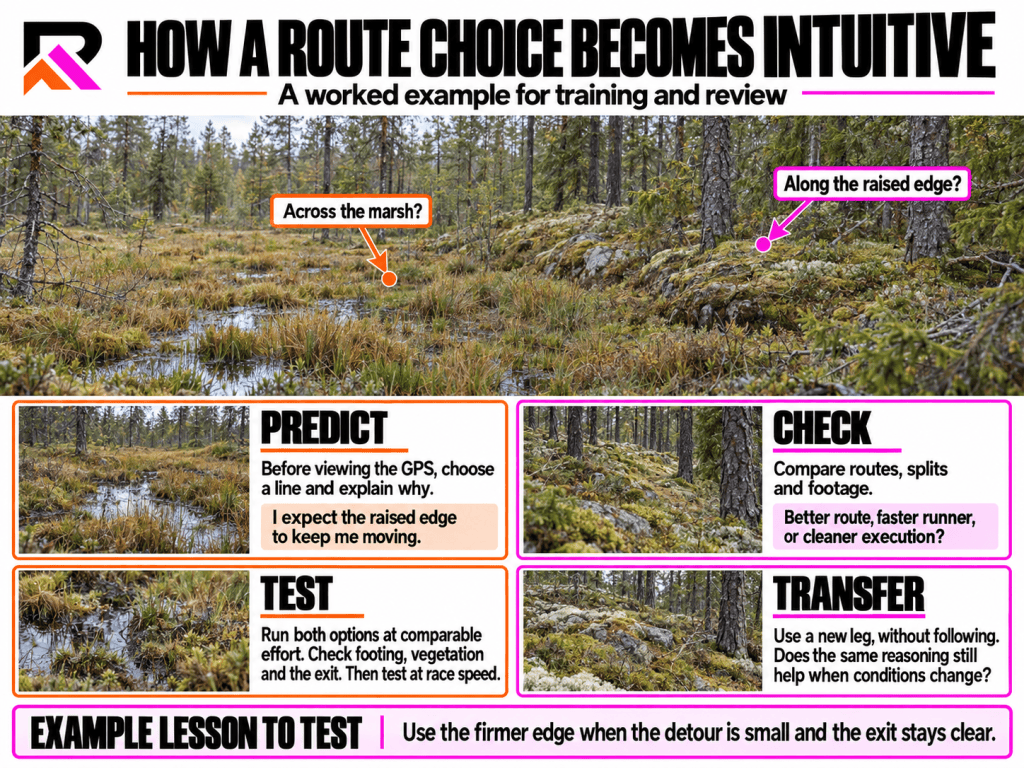
For example: “I would use the raised edge because I expect firmer ground, but I do not know how slow the marsh actually is.”
Then reveal several tracks and compare the splits. Look at where runners agree, where they separate and where time appears to be gained or lost. A repeated tendency to avoid a particular type of ground is worth investigating. A single fast line is an interesting clue. Neither gives you a universal answer.
The fastest athlete may have run faster on an inferior route. Another runner may have chosen well but missed the control. Following, fatigue and differences in terrain-running ability also affect the result. A GPS trace shows the route taken, with some positional uncertainty; it does not show the whole decision process.
When available, add headcam footage and the runner’s explanation. The combination is useful for understanding what was visible, what was anticipated and what caused a change of plan, as discussed in Inside the Runner’s Mind. Watching becomes training when you compare your own prediction with the evidence and identify what to test next.
There is encouraging recent research on specific decision practice. In a 2026 study, 13 Danish national-team orienteers completed a control period followed by six weeks of additional route-choice assessment training. Their average response time on the assessment task improved by about 27%. The small study had no parallel randomised control group and did not demonstrate faster forest races. It supports practising the decision task, while leaving transfer to competition an open question.[3]
Turn each session into better decisions
Suppose your question is whether the raised edge is worth a short detour around a marsh. In training, you take the edge and it feels smooth. That is a useful experience, but you still need to know whether the alternative was better, and why. “It felt good” is a starting point for analysis.
Compare the options fairly
On permitted training terrain, compare both options at similar effort.
- Allow for familiarity. The second attempt on a repeated leg benefits from knowing it.
- Swap routes with a partner rather than comparing two different runners only once.
- Use more than one example of the same problem.
- Record the conditions. Dry and saturated ground can produce different answers.
Find the cause of the difference
Was the direct crossing physically slow? Did vegetation hide the exit? Did you drift and have to correct? Did the edge route give you a clearer attack?
These are different problems. Better fitness, a different line, more precise direction and an earlier plan solve different things.
Write a lesson you can use
Write your own account before opening the comparison: what you expected, what you noticed and where you hesitated. Then check it against the map, GPS, splits and any footage. Review good legs too. You need to understand which decisions produced reliable speed, as well as which ones failed.
A useful training note
“The raised edge preserved my stride, but I lost the advantage by leaving it too late. Next time I will identify the exit before entering the section.”
That gives the next session a clear purpose. “Avoid marshes” would be a much poorer lesson.
Gradually, repeated observations can become a conditional principle: “In this terrain, the firmer edge is often worthwhile when the detour is small and the exit remains clear.” You are learning what to look for, including the conditions that could make a different choice better. The infographic below summarises this work between sessions; it is not a checklist to recite while racing.
Build your preparation in four phases
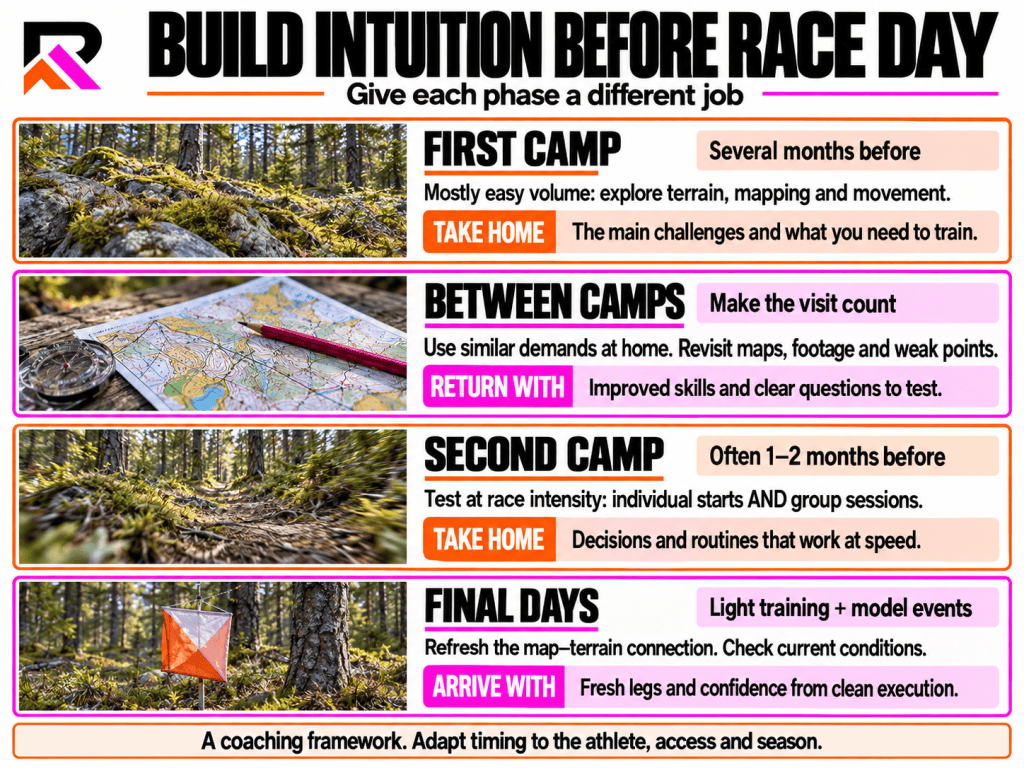
For an important competition in terrain that is not already familiar, two specific camps followed by a short final familiarisation period are the minimum approach I would normally aim for.
This is a coaching recommendation, not a scientifically established number of visits. Timing depends on access, resources, the athlete and the season. Each phase needs to answer a different question.
First camp: understand the terrain
Place the first camp several months before the event when possible. Most of the volume should be at low intensity, giving you time to observe the ground, explore alternatives and understand the mapping. Run through a representative range of slopes, vegetation, marshes and transitions. Stop when a feature does not look as you expected. Work out why.
Pay attention to both navigation and movement. Which contour shapes are easy to recognise? How distinct are vegetation boundaries? Where can you read while running, and where does the footing demand your eyes? Which surfaces repeatedly interrupt your stride? Understanding these details is part of learning the terrain.
Leave with a short preparation brief: the main challenges, the principles that seem useful and the weaknesses to work on at home. If uneven ground is the limiting factor, more route-choice discussion will not solve it alone. If you repeatedly miss subtle shapes, simply getting fitter will not make them easier to interpret.
Between camps: work on the gaps
Use the first visit to shape the following months. Find local terrain with comparable demands, practise the physical skills that limited your options and revisit maps or footage with a specific question. Keep a small collection of examples that challenged your assumptions. You want to return with something improved and something still worth testing.
Second camp: test at race speed
The second camp, often one or two months before the competition, must include meaningful work at competition intensity. As speed rises, you have less time to recognise features, read the map and select your next few metres. A route that felt comfortable while jogging may become awkward when pushing; a slightly longer line may let you maintain much more speed.
The basic principles of navigation remain, but their timing and physical demands change. Test when you look at the map, how far ahead you need to prepare and which references you can actually use at that pace. Low-intensity familiarity cannot answer all of these questions.
Combine individual high-intensity sessions with group sessions.
- Individual starts show whether you can make and execute your own decisions.
- Forked intervals, chasing starts and short duels reveal what happens when someone pulls away or takes another line.
The balance matters, as in Train Offensively, Even When Running Alone.
For example, use a short individual interval course with repeated transitions into low visibility. Review where the plan became late, then use a fresh course on another day. In a group session, check whether each runner knew the intended exit before the pack split. A clean result achieved by following does not tell you whether the athlete’s own routine is reliable.
Keep enough easy training and recovery around these sessions to protect their quality. The camp should leave you with tested principles and a clear sense of what still needs work. Filling every available hour with demanding orienteering can make those lessons harder to interpret.
Final days: refresh and adjust
A few days before racing, use light training and model events in permitted areas to refresh the connection between map and terrain. Check the details most likely to have changed: water levels, vegetation, visibility and footing. Confirm the mapping and practise the routines you intend to use from the first control.
Keep the tasks short and clear, and finish with positive sensations based on clean execution. These days help you adjust and arrive ready. They cannot replace the earlier work, especially if the terrain still feels unfamiliar.
Give your attention a clear task
Trained intuition works within a technical process. In ACE: Analysis, Choice and Execution, experience helps you identify what matters, select a suitable solution and carry it out. With practice, much of this becomes quicker and more economical. You still need direction, a plan and enough feedback to know that it is working.
This is where proactive map reading becomes practical. Before reaching the marsh, identify the intended crossing and the feature you expect beyond it. Before entering a complex slope, understand the shape you will follow and where you will leave it. You give the upcoming terrain meaning before it arrives.
Eccles and Arsal’s review of orienteering expertise describes learned cognitive and behavioural strategies that help experts manage limited attention.[4] My coaching application is to prepare difficult decisions on sections where running and navigation allow it, while maintaining control of the current leg. Good anticipation creates time for the next task.
Replace “focus more” with an action
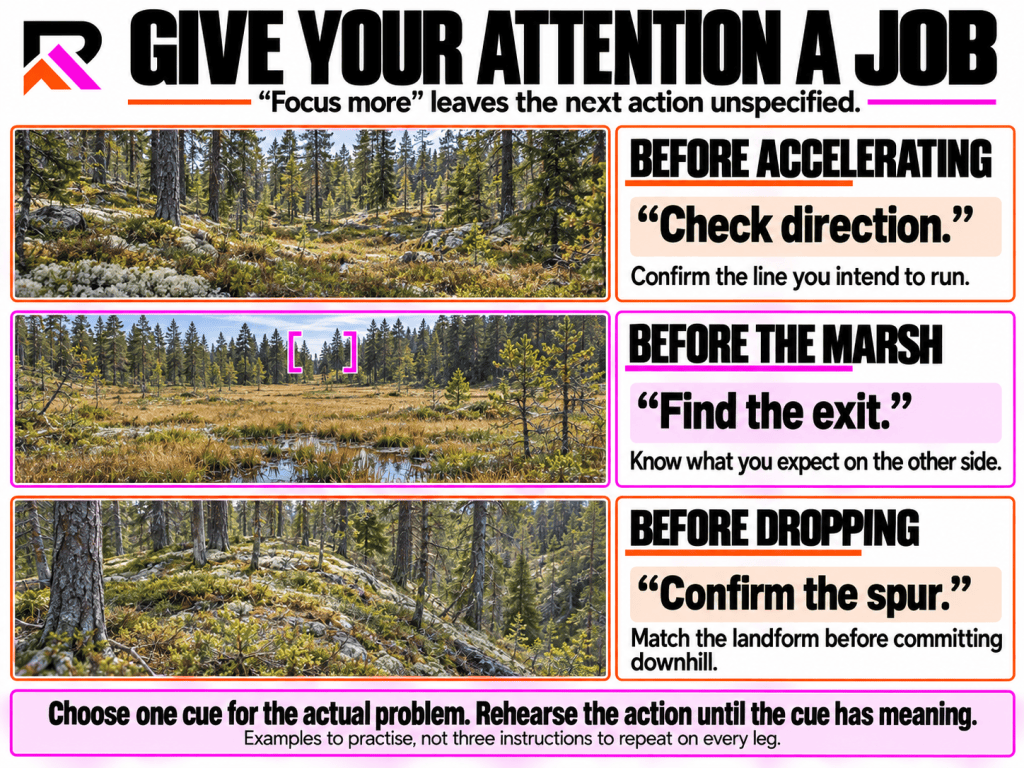
The words we use with ourselves matter here. “Focus more” is understandable, but focus on what? On the compass? The next landform? The marsh exit? We understand the word, but it leaves the next action unspecified. A useful cue tells you where to direct your attention and what to do with it.
Replace it with a task you can carry out:
- “Check direction before accelerating.”
- “Find the exit before entering the marsh.”
- “Confirm the spur before dropping.”
Choose the cue that addresses the actual problem. Giving yourself five instructions at once can be as unhelpful as giving yourself none.
Practise the cue with the behaviour until a short word recalls something precise. “Exit” can become useful shorthand if you have repeatedly trained what it means. The word itself is not the skill; the repeated action gives it meaning. Over time, you need less verbal guidance because the relevant feature starts prompting the action.
Test whether the learning transfers
Test it on a new leg. Run alone. Return after a gap. Change the approach direction or the conditions. As discussed in Developing Orienteering Skills That Transfer to Competition, fluency on a remembered exercise can give a misleading impression of learning. The useful test is whether the same understanding helps you solve a fresh problem.
Look for signs that your judgement is improving:
- Earlier commitment to sensible choices.
- Fewer unnecessary changes of plan.
- Better predictions about runnability.
- Recognition of the exceptions.
Check whether the gain comes with clean execution and reasonable effort. An athlete who confidently applies the same answer everywhere has learned a habit, but may not have learned the judgement behind it.
If the expected feature does not appear, the ground is much slower than anticipated or your position becomes uncertain, give the situation more attention. Reduce speed, check direction and position, and rebuild the plan if needed. Choosing quickly is valuable when the information supports it. Recognising when to reconsider is part of expertise too.
Go back to the course you studied at home. At first, almost every choice raised a doubt. After observing other runners, exploring the terrain, comparing alternatives and testing yourself at speed, you see it differently. You understand more of what each option will demand.
That is the preparation I want athletes to build. When a useful line feels natural in competition, there should be something behind that feeling: ground you have learned to read, decisions you have examined and routines you have tested.
The work is deliberate, even when the decision eventually feels automatic.
Research references
1. Guo, L., Liu, Y., & Kan, C. (2024). The effect of sports expertise on the performance of orienteering athletes’ real scene image recognition and their visual search characteristics. Scientific Reports, 14, 21498.
2. Kahneman, D., & Klein, G. (2009). Conditions for intuitive expertise: A failure to disagree. American Psychologist, 64(6), 515–526.
3. Buch, K., Thomas, R., Staiano, W., & Lønbro, S. (2026). The effect of sport-specific brain endurance training on performance in elite orienteering athletes. Sports, 14(1), 32.
4. Eccles, D. W., & Arsal, G. (2015). How do they make it look so easy? The expert orienteer’s cognitive advantage. Journal of Sports Sciences, 33(6), 609–615.
Discover more from RF-COACH
Subscribe to get the latest posts sent to your email.

