
How to design technical practice that builds lasting learning and holds up on a new map.

You finish a technical session with a good feeling. The controls came smoothly, the compass behaved, and the mistakes from the previous week seem to have disappeared. You leave the forest thinking: this is starting to work.
Then comes a race on a different map. The contours look unfamiliar, the first leg asks for a different rhythm, and the routine that felt so natural in training suddenly needs conscious attention again. That gap deserves a closer look. A clean session is encouraging. But before calling a skill reliable, I want to know what helped the athlete succeed, and what happens when that help changes.
What a good session actually tells us
Learning research distinguishes between the performance we can observe today and the more lasting changes we hope training produces. Soderstrom and Bjork’s review explains why immediate improvement can be a misleading guide to learning: some gains disappear when practice conditions change, while useful learning may develop without an impressive session result. Learning Versus Performance provides the background to this distinction.
For technical training, three questions help:
- Performance: can you carry out the skill during the current session?
- Retention: can you still carry it out after a delay?
- Transfer: can you use it when the task or context changes?
In the forest, these are rarely perfectly separated. A check on a new course several days later tests both retention and transfer. That is useful coaching information, even if it is not a laboratory experiment.
Notice how much the exercise is doing for you
Imagine practising control-exit direction on a familiar map; the typical control-picking training session. The coach reminds you to orient the map and rotate yourself to the perfect direction before each new leg. The legs are short, the objective stays visible in your mind, and you have already visited several of the controls. That can be useful practice. It gives you room to understand the action and repeat it with care. It also provides several supports that may be absent in competition.
You may recognise the hillside before interpreting the contours. You may protect direction because someone has just reminded you. You may remember the control location rather than build a fresh picture of the approach. I would not dismiss the session because of that. I would ask what it is ready to tell us. It may show that you can perform a routine with support. To understand whether the routine is becoming independent, we need another situation.
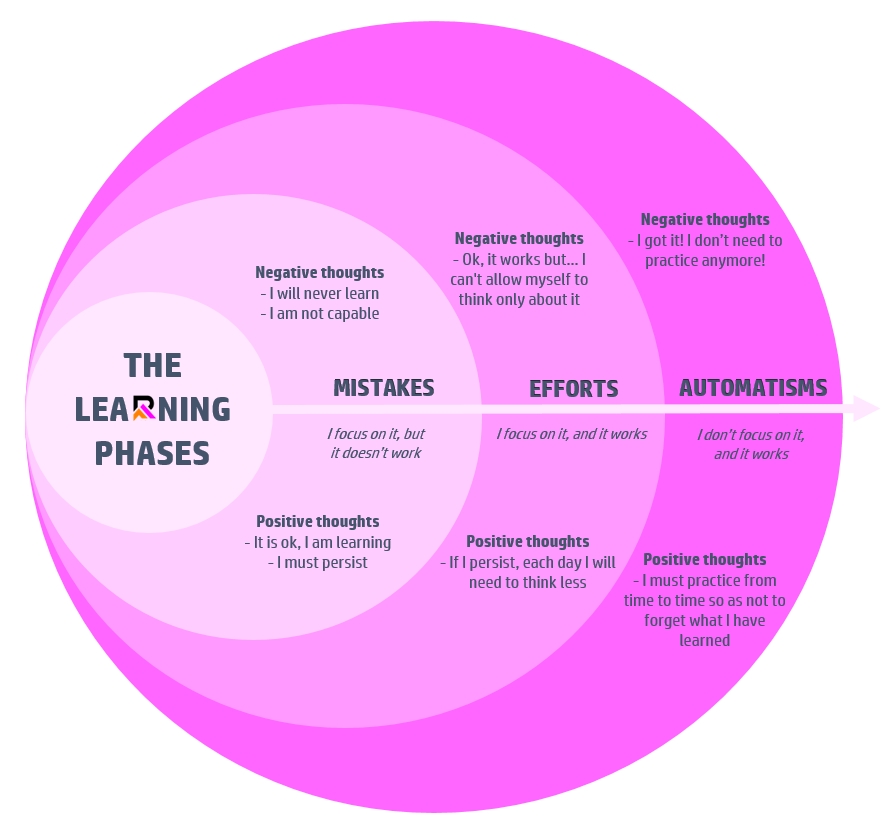
This is especially relevant to the transition described in The Learning Phases: an action that feels automatic in one exercise may still require effort elsewhere.
Keep the process consistent; let the decisions change
The ACE system gives us a useful structure: Analysis, Choice and Execution. In Part 2, I explored how that process can remain dependable in competition. Training transfer asks how we develop that dependability.
Take control approach as an example. The purpose is to recognise what the circle demands, choose an appropriate way in, and maintain the necessary direction and map contact. The best solution will change. One control may offer a distinct attack point; another may require a broader terrain picture and careful compass work through a diffuse area. If every practice leg offers the same obvious attack point, the exercise leaves part of that judgement untested. I want the athlete to encounter different approaches while continuing to organise the problem through ACE.
That also means preserving the connection between reading and moving. The concept of representative learning design emphasises practice that retains important relationships between information and action. My application to orienteering is straightforward: map analysis indoors can prepare a decision, but some sessions must require the athlete to recognise the relevant terrain information and act on it while running.
A short exercise can do this well. It does not need the length, fatigue or atmosphere of a full race.
A practical progression: establish, vary, integrate, verify
Here is a framework I propose for planning technical development. It is a coaching application of learning principles and ACE, rather than a validated orienteering protocol. The stages can overlap, and you can return to an earlier stage when the task reveals something that needs attention.
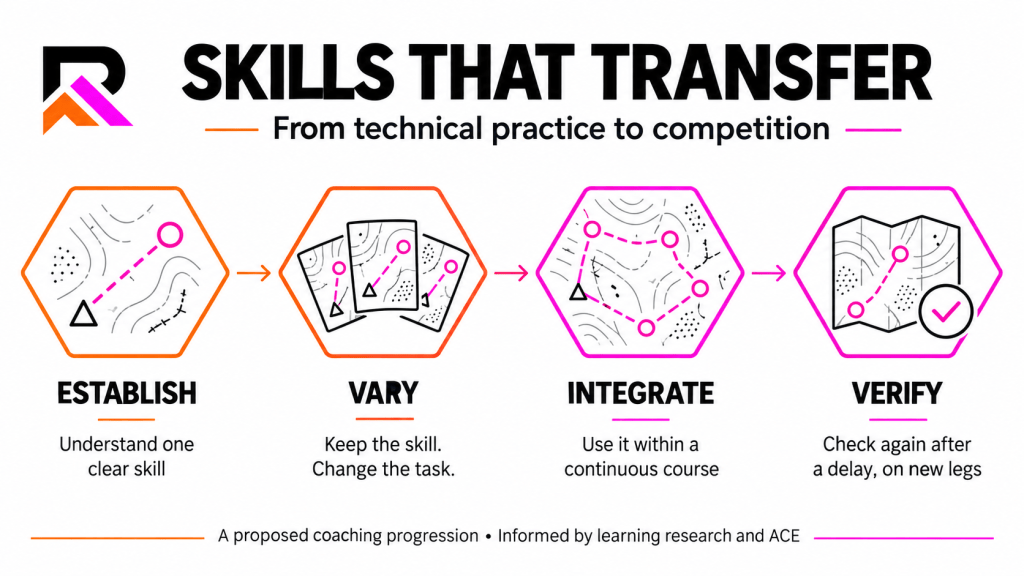
Choose one clear target first. For the example below, it is leaving each control with an intended direction and an identifiable first reference.
| Stage | How to practise | What to look for |
|---|---|---|
| 1. Establish | Use short, manageable legs at an easy pace. Allow a deliberate pause to plan. A coach can demonstrate or prompt the routine. | The athlete understands the purpose of the direction check and can identify the first useful reference. |
| 2. Vary | Keep the target, but change exit angles, visibility or terrain features. Use fresh legs and gradually reduce reminders. | The athlete prepares each exit from the map and terrain information, without relying on the previous solution. |
| 3. Integrate | Place the target inside a continuous course. Include changes of rhythm, such as a precise exit after a fast running section. | The routine appears without a prompt, alongside the other demands of navigating. Speed remains adjustable. |
| 4. Verify | After several days, use new legs of comparable difficulty, ideally in a less familiar area. Avoid advance rehearsal and reminders during the check. | The athlete still initiates the routine and can adapt it to the new situation. Review repeated patterns, not one clean leg. |
“Several days” is a practical example, not a scientifically established interval for orienteering. Likewise, these stages are not four compulsory sessions. Their timing depends on the athlete, the terrain available, and the training objective.
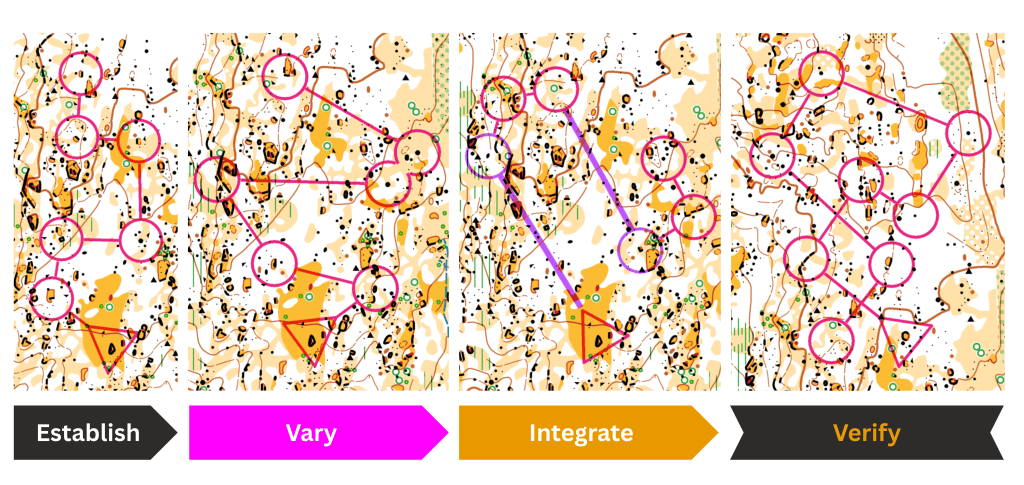
If you only have one local map, transfer work is still possible. Change the order of controls, approach an area from another direction, or use an unfamiliar part of the map. Be honest about the remaining familiarity: useful variation and new terrain provide different tests.
Adjust the challenge so the athlete can learn from it
Variety needs a purpose. Research on contextual interference, mixing tasks or variations instead of practising them in separate blocks, offers reasons to explore it, but the findings are not a universal instruction to randomise training. A 2024 systematic review and meta-analysis found an overall transfer advantage for random practice, while the effect in applied settings was smaller and statistically non-significant. The evidence does not establish an optimal practice schedule for orienteering.
The challenge point framework offers another useful perspective: the difficulty of a task depends partly on the skill of the person attempting it. The same leg can provide meaningful practice for one athlete and an overwhelming problem for another.
My practical rule is to change one major demand at a time when diagnosing a weakness. If you raise speed, reduce visibility, remove support and add head-to-head pressure together, it becomes difficult to understand what caused the breakdown.
Look for a challenge the athlete can interpret. Can they explain the point where the plan became unclear? Can they make a relevant adjustment on the next leg? If they repeatedly lose contact without understanding why, simplify the task or restore some support.
A mistake is useful when it gives us something we can work with. Collecting mistakes alone is not a training objective.
Use feedback to develop the athlete’s own diagnosis
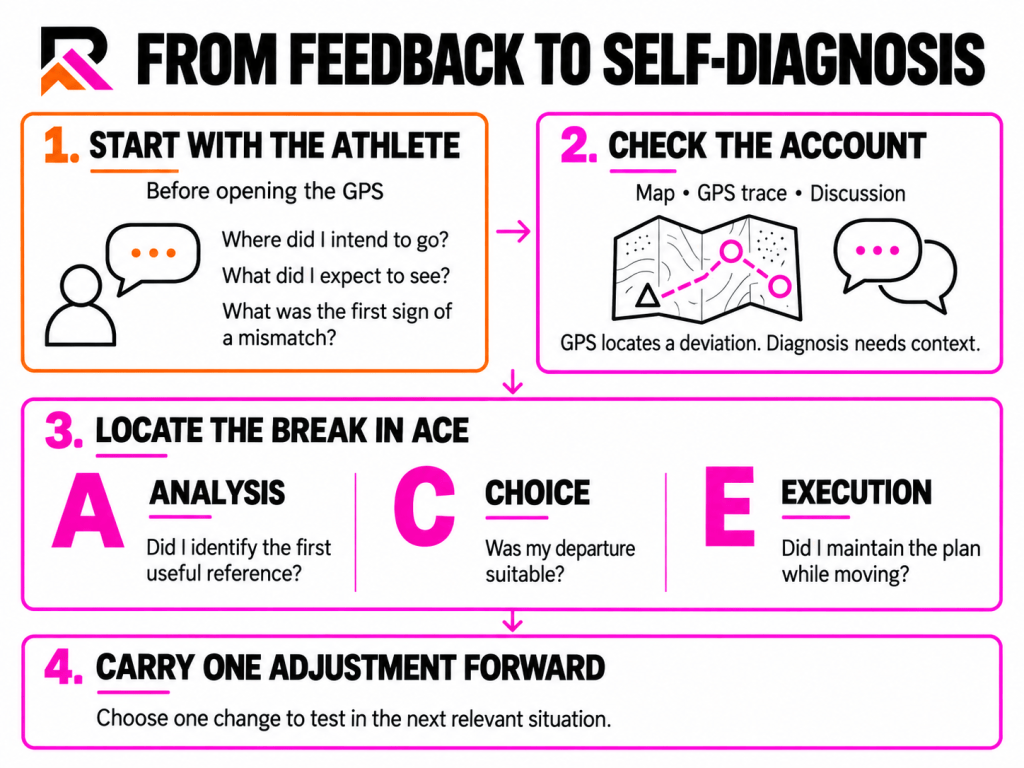
For a review, I would start with the athlete’s account before opening the GPS tracking. Where did you intend to go? What did you expect to see? What was the first sign that the plan and terrain no longer matched?
Then use the map, tracking, and discussion to check that account. A GPS line can show a deviation, but it cannot by itself tell us whether the athlete misread a contour, made an uncertain choice or stopped protecting direction.
Bring the review back to ACE. Was the first reference poorly identified in Analysis? Was the chosen departure unsuitable? Or was there a workable plan that was lost during Execution? End with one adjustment the athlete can carry into the next relevant situation. Feedback remains available; the aim is to develop an athlete who can increasingly recognise when it is needed and what question to ask.
Judge progress across situations
When reviewing the progression, I would record a few simple observations: whether the routine appeared without a reminder, whether the athlete kept contact with the intended references, and whether an error was recognised and corrected before it grew.
Include pace and task difficulty in the notes. An error-free jog on easy legs and a controlled effort through demanding terrain tell us different things. Faster splits are valuable, but they need to be interpreted alongside the decisions that produced them.
Also consider the athlete’s condition. As discussed in The Hidden Load in Orienteering Performance, technical clarity can change with the broader demands surrounding training. A difficult day should lead to a diagnosis, rather than an immediate conclusion that nothing has been learned.
My aim is for a good training session to leave something the athlete can use beyond that particular course: a clearer way to analyse, a more appropriate choice, or an execution routine that returns when it is needed.
Enjoy the clean sessions. Then give the skill another opportunity to show itself—after a delay, on fresh legs, and eventually in competition. That is where confidence in the work becomes better grounded.
References and further reading
- Soderstrom, N. C., & Bjork, R. A. (2015). Learning Versus Performance: An Integrative Review. Perspectives on Psychological Science, 10(2), 176–199.
- Guadagnoli, M. A., & Lee, T. D. (2004). Challenge Point: A Framework for Conceptualizing the Effects of Various Practice Conditions in Motor Learning. Journal of Motor Behavior, 36(2), 212–224.
- Pinder, R. A., Davids, K., Renshaw, I., & Araújo, D. (2011). Representative Learning Design and Functionality of Research and Practice in Sport. Journal of Sport & Exercise Psychology, 33(1), 146–155.
- Czyż, S. H., Wójcik, A. M., & Solarská, P. (2024). The Effect of Contextual Interference on Transfer in Motor Learning: A Systematic Review and Meta-analysis. Frontiers in Psychology, 15, 1377122.
Discover more from RF-COACH
Subscribe to get the latest posts sent to your email.

