
This article aims to provide orienteers and their coaches with an understanding of the importance and benefits of uphill training, by incorporating structured uphill workouts into their training programs, orienteers.

Orienteering is a unique sport that combines navigation and endurance running, often across rugged terrain. Uphill training is a crucial component for orienteers, providing significant benefits in strength, endurance, and technical skills required for navigating hilly landscapes. This article briefly explores the importance of uphill training for orienteers, the physiological benefits, and provides practical examples and training targets.
Importance of Uphill Training
Enhancing Strength and Power
Running uphill requires significant muscular strength, particularly in the lower body. Key muscle groups engaged include:
- Quadriceps: For knee extension.
- Hamstrings and Glutes: For hip extension.
- Calves: For plantarflexion.
Uphill running strengthens these muscles more effectively than flat running due to the increased resistance, leading to improved power and running economy.
Improving Cardiovascular Endurance
Uphill running elevates heart rate and demands higher oxygen consumption, thereby improving cardiovascular endurance. This intense cardiovascular workout enhances:
- VO2 Max: The maximum amount of oxygen the body can utilize during intense exercise.
- Lactate Threshold: The point at which lactate begins to accumulate in the blood, allowing orienteers to maintain higher intensities for longer periods.
Boosting Mental Toughness
Navigating hilly terrains requires mental resilience. Uphill training builds the mental toughness needed to push through challenging courses, an essential trait for competitive orienteering.
Technical Skill Development
Running uphill in varied terrain simulates real orienteering conditions, improving:
- Foot Placement: Navigating uneven surfaces.
- Balance and Coordination: Maintaining stability on steep gradients.
- Navigation Under Stress: Making quick, accurate decisions while physically taxed.
Physiological Benefits of Uphill Training
Cardiovascular System
Increased Stroke Volume and Cardiac Output
Uphill running increases the workload on the heart, promoting adaptations such as increased stroke volume (the amount of blood pumped per beat) and cardiac output (the overall blood volume pumped by the heart per minute). These adaptations enhance overall cardiovascular efficiency.
Muscular System
Muscle Fiber Recruitment
Uphill running recruits a higher percentage of fast-twitch muscle fibers, which are crucial for generating power and speed. This not only builds muscle strength but also improves muscle endurance, making the muscles more resilient to fatigue.
Metabolic Adaptations
Improved Aerobic Capacity
The increased intensity of uphill running boosts aerobic capacity, improving the body’s ability to deliver and utilize oxygen efficiently. This adaptation is crucial for prolonged orienteering events.
Enhanced Lactate Clearance
Regular uphill training enhances the body’s ability to clear lactate, delaying the onset of fatigue and allowing orienteers to maintain higher intensities for longer periods.
Injury Prevention Benefits of Uphill Training
Uphill running is a powerful tool for injury prevention due to its lower impact nature compared to flat or downhill running. The primary reasons include:
Reduced Impact Forces
Running uphill reduces the impact forces exerted on the joints, especially the knees and hips. This lower-impact environment minimizes the risk of common running injuries such as patellofemoral pain syndrome and iliotibial band syndrome.
Strengthening Stabilizing Muscles
Uphill training enhances the strength of stabilizing muscles, particularly the glutes and core, which play a crucial role in maintaining proper running form and preventing overuse injuries.
Improving Muscular Balance
By emphasizing different muscle groups compared to flat running, uphill training helps to correct muscular imbalances. Stronger glutes and hamstrings reduce the risk of injuries like hamstring strains and lower back pain.
Transference to Running Speed
The benefits of uphill training transfer significantly to flat running speed and overall performance. Key aspects include:
Enhanced Power and Efficiency
The increased strength and power gained from uphill running improve running economy on flat terrain. This means orienteers can run faster with less effort, maintaining higher speeds over longer distances.
Improved Stride Mechanics
Uphill running encourages a higher knee drive and longer stride, which translates to more efficient biomechanics on flat surfaces. This improved form reduces energy expenditure and enhances speed.
Increased Anaerobic Capacity
The intense nature of uphill repeats boosts anaerobic capacity, enabling orienteers to sustain higher speeds during critical moments of a race, such as sprinting to a control point or finishing strong.
Uphill Training Examples and Targets
Training Session Examples
Hill Repeats (Short):
- Intensity: High
- Duration: 30-60 seconds uphill, with 2-3 minutes recovery jogging downhill.
- Sets: 6-10 repetitions.
- Target: Increase anaerobic power and muscle strength.
- Orienteering Integration: Use this session to simulate race conditions by adding a navigation component. For example, set up a control point at the top of the hill, requiring control direction and basic map reading at each interval.
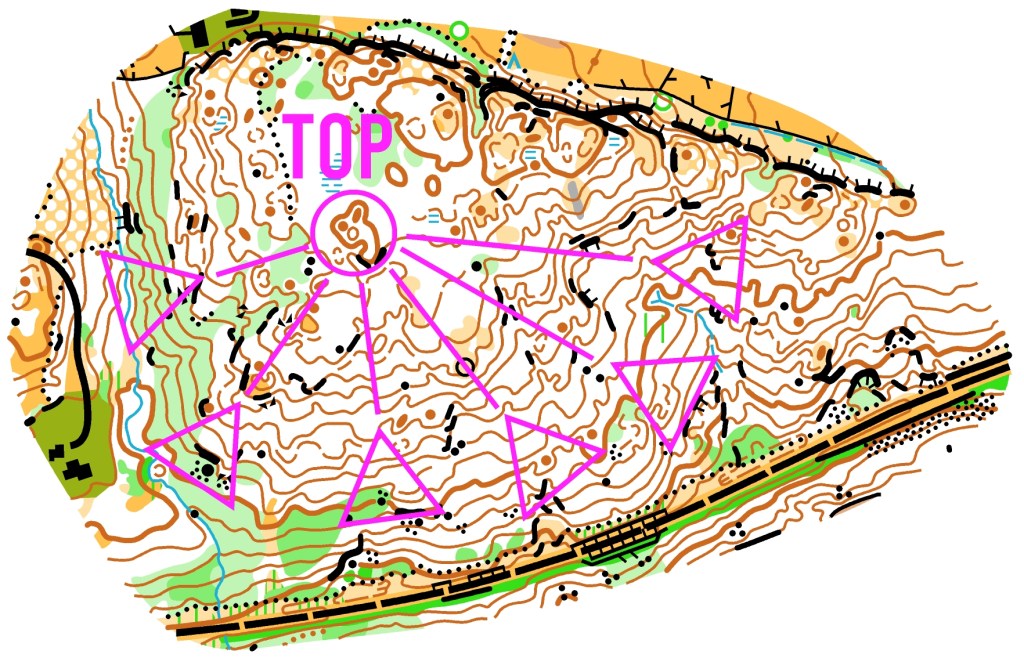
Hill Repeats (Long):
- Intensity: Moderate to high
- Duration: 5 minutes uphill, with 3-5 minutes recovery jogging downhill or on flat terrain.
- Sets: 4-6 repetitions.
- Target: Improve aerobic capacity and lactate threshold.
- Orienteering Integration: Incorporate longer orienteering legs in hilly terrain. Plan a route that requires navigating multiple control points within the uphill section, focusing on maintaining speed while reading the map.

Continuous Uphill Run:
- Intensity: Moderate to high.
- Duration: 20-30 minutes continuous run on a steady incline.
- Target: Enhance aerobic capacity and muscular endurance.
- Orienteering Integration: Use a continuously uphill terrain to practice route choices. Compare different route choices to each control point and their impacts on overall performance.

Fartlek on Hilly Terrain:
- Intensity: Variable (alternating hard and easy efforts by time or by feeling).
- Duration: 45-60 minutes.
- Target: Improve both aerobic and anaerobic systems, as well as mental toughness.
- Orienteering Integration: During the hard efforts, simulate race speed to various control points, followed by easier efforts where the focus shifts to precise navigation and recovery. Tip! You can use simplified maps with only contours to focus more on the terrain forms.

Orienteering Sævig intervals:
- Intensity: High
- Duration: 3-5 minutes uphill by path, with 3-5 minutes tricky downhill orienteering.
- Sets: 3-6 repetitions.
- Target: Enhance eccentric muscle strength, downhill running technique, and lactate threshold.

Physiological Targets
| Training Type | Intensity | Duration | Frequency | Physiological Target |
|---|---|---|---|---|
| Hill Repeats (Short) | High | 30-60 sec | 1-2 times/week | Anaerobic power, muscle strength |
| Hill Repeats (Long) | Moderate | 5 min | 1 time/week | Aerobic capacity, lactate threshold |
| Continuous Uphill Run | Moderate | 20-30 min | 1 time/week | Aerobic capacity, muscular endurance |
| Fartlek on Hills | Variable | 45-60 min | 1-2 times/week | Aerobic/anaerobic capacity, mental toughness |
| Orienteering Sævig Intervals | High | 3-5 min | 1 time/week | Eccentric strength, downhill, lactate threshold |
Conclusion
Uphill training is indispensable for orienteers aiming to enhance their performance. By targeting specific physiological adaptations such as increased cardiovascular efficiency, muscle strength, and lactate threshold, uphill training prepares orienteers for the physical and mental demands of the sport. Additionally, the lower impact nature of uphill running helps prevent injuries, and the improved power and efficiency translate directly to faster running speeds on flat terrain. Implementing structured uphill workouts into a training regime, while integrating orienteering elements, can lead to significant improvements in overall performance. This ensures that orienteers are well-equipped to tackle the challenging terrains they will encounter in competitions.
Bibliography
- Bergh, U. (1987). Influence of body mass on performance in cross-country skiing. Medicine and Science in Sports and Exercise, 19(4), 324-331.
- Midgley, A. W., McNaughton, L. R., & Jones, A. M. (2007). Training to enhance the physiological determinants of long-distance running performance. Sports Medicine, 37(10), 857-880.
- Saunders, P. U., Pyne, D. B., Telford, R. D., & Hawley, J. A. (2004). Factors affecting running economy in trained distance runners. Sports Medicine, 34(7), 465-485.
- Barnes, K. R., & Kilding, A. E. (2015). Running economy: measurement, norms, and determining factors. Sports Medicine – Open, 1(1), 8.
- Billat, V. L., Demarle, A., Slawinski, J., Paiva, M., & Koralsztein, J. P. (2001). Physical and training characteristics of top-class marathon runners. Medicine & Science in Sports & Exercise, 33(12), 2089-2097.
Discover more from Orienteering Coach
Subscribe to get the latest posts sent to your email.
 Orienteering Coach
2 thoughts on “Unleashing your potential: 🏔️ Uphill training for orienteers.”