
Technical execution is one of the key factors behind performance in orienteering. For both athletes and coaches, analysing execution in detail is essential to identify recurring patterns under competition pressure. Some of these patterns reflect solid routines that support performance. Others reveal habits that need adjustment. The better we understand them, the better we can refine training, correct what is not working well enough, and reinforce what consistently works.
The difficulty is that technical analysis is often incomplete when based on a single source. A route may show where time was lost, but not fully explain why. An athlete’s explanation adds context, but not always the full picture of what happened in the moment. When route, headcam footage, and athlete commentary are combined, however, the analysis becomes much more precise. This kind of material allows us to examine not only the outcome but also the decision-making process behind it.
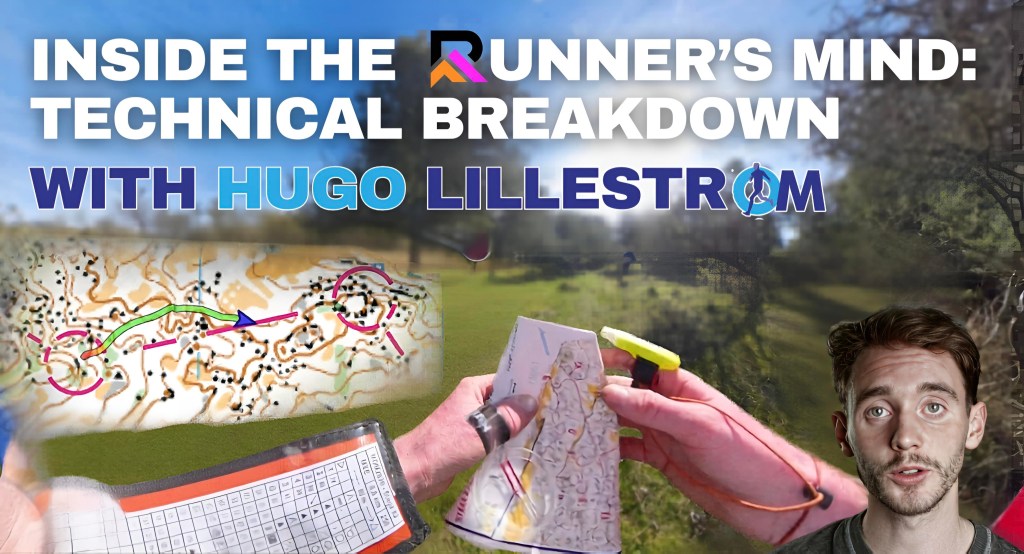
This article uses material published by Hugo Lilleström, with his prior permission, to highlight a selection of technical situations that may be especially valuable for the reader. It is not intended as a complete analysis of the race, but rather as a practical example of how this type of material can support technical improvement.
This analysis is intended purely as a didactic exercise. The aim is not to criticise the athlete’s execution, but to use this valuable material to highlight technical patterns, decision-making processes, and lessons that may help athletes and coaches better understand performance in competition.
Who is Hugo Lilleström?
Hugo Lilleström is a Swedish elite orienteer and content creator based in Falun. Raised in an orienteering family, he has been involved in the sport from an early age, later attending an orienteering-focused high school in Eksjö and progressing to the elite level. Through his YouTube channel, he shares content about orienteering and life as a high-level athlete, including headcam videos that let viewers experience races from the athlete’s perspective, sometimes with commentary on route choices, mistakes, and key moments.
What are we analysing here?
The focus of this article is Hugo Lilleström’s race in the Middle Distance at Maximus O Meeting 2026 (where I was the course-setter). Rather than reviewing the course from start to finish, the aim is to select several specific moments that reveal interesting technical behaviours, such as route choice decisions, simplification, hesitation, changes of plan, or examples of effective and ineffective control under pressure. Looking closely at these situations through the combination of route, headcam footage, and athlete commentary allows for a more precise understanding of how the execution develops in real racing conditions.
Moment 1. A dangerous “easy” first control
Video time: from the start to control 1
📽️ What happens
The first control is not especially complex on paper, but the final part of the leg lacks full precision. The approach into the circle is not supported by a sufficiently clear attack plan, and this results in a small mistake close to the control.
🧠 What is going through the runner’s mind
Hugo describes it as “quite an easy control”, but also points out the risk of running too fast and becoming slightly stressed. That combination is interesting in itself. The leg is perceived as manageable, yet the athlete is aware that the start of the race can easily lead to rushed execution.
🔍 Technical view
This is a very relevant example of why the opening leg of a race deserves special respect. The mental preparation before the start is of enormous importance. Just as the body needs a physical warm-up, the brain also needs time to reach its optimal level of technical functioning. The first leg, especially in demanding and unfamiliar terrain, should therefore be approached with maximum care. At this stage of the race, the priority should not be speed, but stability. The athlete should allow the brain to enter the map-reading process smoothly, using slightly more support than would normally be needed later in the race. Extra structure, more deliberate reading, and a fully controlled approach into the circle are often good investments in the opening minutes.
There is also an important lesson in the way the control is described. Labelling a leg as “easy” can be surprisingly dangerous. During the race, it is usually more effective to avoid judging difficulty in those terms and instead focus on an objective technical assessment of the leg: possible obstacles, lines of good progression, direction, supporting features, and the structure of the final approach. Once the brain classifies a leg as easy, it tends to relax and switch into a simplified reading mode. In many cases, that is exactly the opposite of what is needed. Paradoxically, a large number of mistakes in orienteering happen precisely on the legs that feel easiest. Not because they are truly demanding, but because they are approached with slightly less discipline, slightly less structure, and slightly less respect than they deserve.
🎯 Coaching takeaway
You never win a race at the first control, but you can certainly lose it there. In an important race, the right mindset for control 1 is simple: approach it as if you had to place the flag yourself. Full control, full precision, no shortcuts in concentration.
Moment 2. No plan, no control
Video time: control 2 to control 3
📽️ What happens
After an unsettled start to the race, including the small mistake at control 1 and a second leg with a visible lack of control, Hugo reaches the leg to control 3 still carrying the stress generated by the opening section. Instead of resetting, he tries to compensate for the time already lost by increasing the pace. The result is a leg without structure, without control, and eventually without direction, ending in a situation of complete confusion.
🧠 What is going through the runner’s mind
His own comments describe the situation very clearly: “I do not have any plan on this leg, and that is quite bad; you should have.” A few seconds later, he adds: “I try to sprint a lot here. That is because I think now I need to take back the time I lost in the beginning. That is not a good sign.” The sequence ends with perhaps the most revealing statement of all: “I am extremely lost here, and I don’t know what I’m doing here.”
These comments show a progressive collapse in control. First, the absence of a plan. Then, the emotional reaction to previous mistakes. Finally, the loss of orientation and understanding. He is clearly aware that these are not constructive reactions and that they are unlikely to help him, yet he is unable to regain control and move towards the behaviours he knows would be more effective. In that moment, instinct overrides conscious decision-making.
🔍 Technical view
This is a very common pattern after a poor start. The first instinct is often to rush, raise the intensity, and try to recover the lost time immediately. The idea seems logical in the moment, but in practice it almost never leads to anything positive. On the contrary, it usually increases stress levels, reduces clarity, and creates the conditions for further mistakes.
Recovering after an error is not easy. Resetting the system under competitive pressure is one of the most difficult skills in orienteering, but it is also one of the most trainable. Mistakes may happen to anyone. What matters is how the athlete responds once they happen. That response is not only emotional, but also technical. If the reaction is impulsive, the race often continues to drift further away. If the reaction is controlled, the athlete gives himself a real chance to stabilise the execution again.
The second key element in this fragment is the lack of planning. When there is no plan, the athlete is no longer executing proactively, but improvising. Improvisation reduces control over the leg and breaks the global picture of the route. Without a clear plan, two consequences usually appear at once: the risk of error increases, and the speed drops in a more fundamental sense, because the athlete is moving without true direction or purpose. In other words, running fast without a plan is not real speed. It is only rushed movement. Real speed in orienteering comes from clarity, structure, and control.
🎯 Coaching takeaway
Always have a plan for every leg. Always. If you do not have one, stop for a few seconds, analyse, decide, and then run. And after a mistake, the priority is not to chase lost time, but to reset mentally and technically. Take a breath, clear the previous error from your mind, and return to the race as if it were a new beginning, a new control 1. What happened before must not be allowed to shape the next decision.
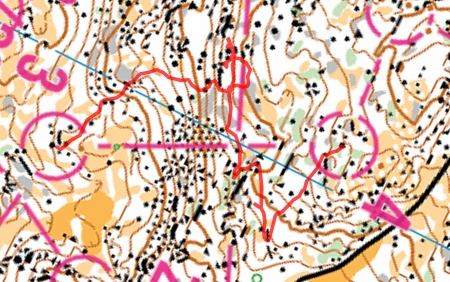
Note: A similar pattern can also be observed on the leg from control 3 to control 4. The same technical principles discussed above remain clearly visible, although in this case the execution breaks down more clearly and the time loss is greater. It is not examined in detail here in order to avoid unnecessary repetition, as the purpose of this article is didactic rather than a complete leg-by-leg analysis.
Moment 3. Changing a good plan for no real reason
Video time: control 13 to control 14
📽️ What happens
By this point in the race, a significant part of the course has already passed and the technical execution has become more stable and fluent. On the leg from control 13 to control 14, Hugo appears to have a clear initial plan for how to solve the leg. However, near the end of the execution, he abandons that plan and chooses a different option without a strong technical reason to justify the change.
🧠 What is going through the runner’s mind
He explains the situation very openly: “My plan was to go around and take the control from the right. But, for some reason, I don’t know why, I felt like oh it’s too big hill, I need to go left. It’s not a good decision.”
What is especially interesting here is that the athlete recognises both the original intention and the weak nature of the change. The shift is not presented as a conscious re-evaluation based on new information, but rather as an instinctive reaction triggered while running.
🔍 Technical view
From a technical point of view, the positive element comes first: the athlete establishes a plan for the leg. This suggests a correct planning process, likely based on an assessment of the full route, the main obstacles, the best lines of progression, and the control approach itself, even if not all of this is stated explicitly in the commentary. Once this process has been carried out properly, it becomes very important to stick to the plan. A conscious plan is usually the best option the athlete has identified before entering the leg. That matters, because it is the result of structured reading and deliberate decision-making, not of impulse.
Of course, plans can sometimes be changed, and in some cases they should be. But for that change to be positive, it should respond to a strong reason: perhaps something important was missed in the original analysis, or perhaps an execution error has created a new position from which a different solution becomes more effective. What should be avoided is the interactive, half-instinctive change that appears while running, based only on a vague feeling that something else might be better. If the change is not conscious and well founded, it is rarely beneficial. In most cases, it costs both time and fluency. The athlete not only leaves the original structure behind, but also interrupts the rhythm and clarity that came with it.
🎯 Coaching takeaway
If the planning routine has been done properly, trust it. Do not change the plan unless there is a clear and meaningful reason to do so. A good plan abandoned on impulse is often worse than an average plan executed with full commitment.
Moment 4. Choosing control over uncertainty
Video time: after the spectator passage, on the way to control 16
📽️ What happens
After the spectator passage, Hugo heads into the final loop of the course towards control 16. At this stage, his concentration is clearly better, the emotional noise from the early part of the race has faded, and the execution becomes more composed. In this leg, he applies an interesting tactical solution: rather than attacking the control directly, he deliberately positions himself slightly to the right in order to remove uncertainty from the final approach.
🧠 What is going through the runner’s mind
He explains it very clearly: “I feel I have a good focus here. I’m not that angry anymore.” He then describes the tactical idea behind his choice: “I was aware of going a little bit to the right, so I could know I was to the right. At these controls, you can lose a little bit of time if you try to take them straight on, because you don’t know which side you are. So, I go a bit to the right here, so that I know when I will be in the yellow, I will need to turn left to the control.”
This is a very valuable insight, because it shows not only technical awareness, but also a more mature tactical approach. The athlete is no longer reacting emotionally. He is reading the demands of the terrain and choosing a solution that maximises certainty.
🔍 Technical view
This is a very good example of the importance of tactical thinking in orienteering. Performance is not only shaped by pure execution, but also by the quality of the decisions that guide that execution. Terrain familiarity, previous experiences, and accumulated feelings for the map style can all become highly valuable when used as a strategic framework for decision-making. That is one of the reasons why preparation in relevant terrain is so important before a major championship. The more experience an athlete builds in terrain with similar demands, the more refined the tactical responses tend to become. This does not only improve confidence, but also helps the athlete recognise which types of solutions are most reliable under pressure.
In highly complex terrain like the one involved here, and in orienteering more broadly, decisions that prioritise control over uncertainty are often very effective. Instead of choosing the most direct option in geometric terms, Hugo chooses the option that gives him a cleaner reference and removes ambiguity from the final metres. That is a very strong tactical choice. It may look slightly less aggressive on paper, but in practice, it increases precision and supports smoother execution. Very often, the fastest solution in complex terrain is not the most direct one, but the one that allows the athlete to do something simple with full control.
🎯 Coaching takeaway
Use your experience and your knowledge of the terrain to guide decision-making. In complex terrain, a very effective principle is often this: do simple things well executed.
A big thank you to Hugo Lilleström for sharing such valuable material and for giving permission to use it in this article. Content of this kind is not only interesting to watch, but also highly relevant from a coaching and educational perspective. For athletes, coaches, and anyone interested in the technical side of orienteering, it offers a rare opportunity to look beyond the result itself and gain insight into the real processes that shape performance. If you do not know Hugo’s work yet, I strongly encourage you to follow his YouTube channel. His videos provide an excellent combination of high-level racing, athlete perspective, and thoughtful commentary, making them both enjoyable and useful for anyone who wants to better understand the sport. Hopefully, he will continue creating this kind of content in the future, because it brings real value to the orienteering community.
Detailed analysis of races and training sessions remains one of the most powerful tools for athlete development. To improve consistently, it is not enough to look only at the visible execution. We also need to understand the thoughts, decisions, and reasoning that shaped that execution in the first place. Very often, the key to improvement lies not only in what the athlete did, but in why it was done that way. One of the most effective methods in this process is shadowing, where the coach follows the athlete during a training session, maintains a dialogue, and stops at selected moments to discuss decisions, perceptions, and technical choices. Used well, this can be even more powerful than hours of post-training technical analysis, because it gives direct access to the athlete’s thinking in the moment itself. But we will talk about that in another article!
If you would like to read more about related topics, I recommend the following previous articles:
- How to React Against a Mistake?
- The “ACE” System for Orienteering
- Mastering the Mental Game in Orienteering
- Proactive vs Reactive Map Reading in Orienteering
Discover more from RF-COACH
Subscribe to get the latest posts sent to your email.
 RF-COACH
A very thoughtful and useful article. Thank you!
LikeLiked by 1 person