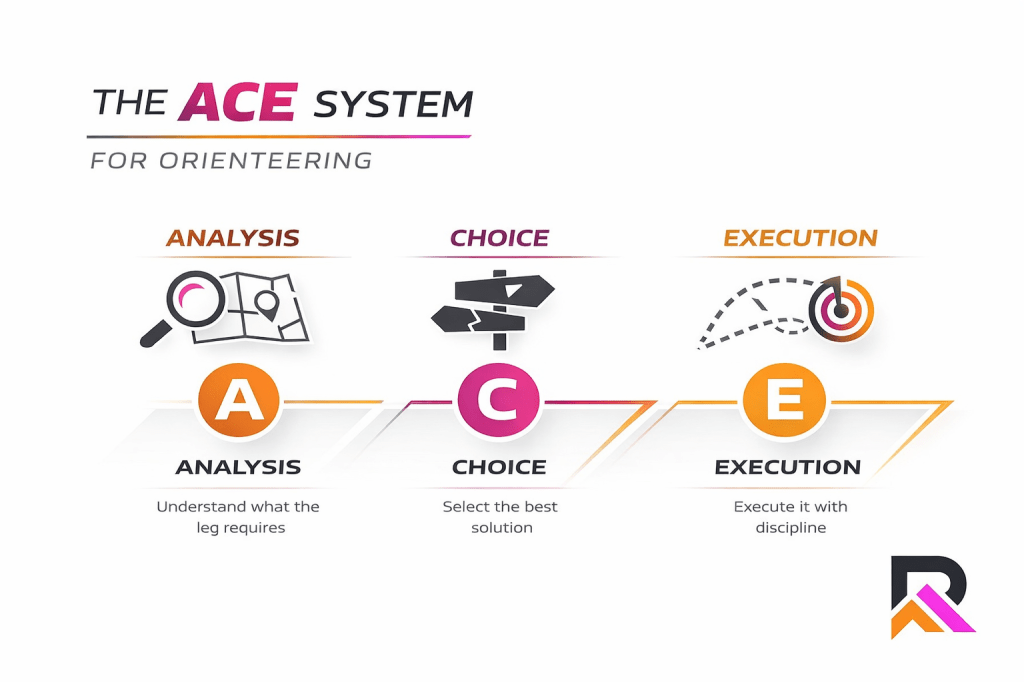
In the first part, I introduced the ACE system (read the article here) as a simple framework to understand technical performance in orienteering. ACE stands for Analysis, Choice and Execution, three phases that shape almost every leg, regardless of terrain, format, or race level.
The model itself is straightforward. The real challenge is something else. Can the athlete still apply it when the race becomes fast, tiring, emotional, and uncomfortable? That is where the technical level is truly exposed. A system is not valuable because it looks logical on paper. It is valuable when it still works in the forest, at race speed, after a mistake, under pressure, and in the final part of a race when the body is tired, and the mind wants to rush.
At a high level, the difference is rarely about a lack of information. Most experienced orienteers already understand map reading, route choice, and control approach reasonably well. The bigger problem is that this knowledge does not always hold together in competition. They know what good orienteering looks like, but they do not always reproduce it when the race demands precision, discipline, and calm decision-making.
This is exactly where ACE becomes useful. It gives the athlete a repeatable technical process, and it gives the coach a much more precise way to understand performance. Not just that the athlete made a mistake, but why the mistake happened, where the process broke, and what must be trained to make performance more reliable.
From technical knowledge to technical reliability
One of the most common coaching observations in orienteering is that technically capable athletes often perform inconsistently. They can look excellent one day and unstable the next. They are not short of knowledge. They are short of process stability. This distinction matters.
There is a big difference between understanding the sport and functioning well inside it. Knowledge helps the athlete recognise what should be done. A reliable process helps him do it repeatedly, even when the race starts to create noise.
Without that process, performance depends too much on rhythm, confidence, emotion, and race context. When things feel good, the athlete orienteers well. When pressure rises, the structure starts to weaken. As decisions become more reactive, the connection to the map becomes more fragile, and a single mistake can quickly damage the next part of the race as well.
That is why the goal of ACE is not to make orienteering rigid. It is to make it dependable.
A strong athlete should not need to rebuild his decision-making from zero on every leg. He needs a clear framework that helps him recognise what matters, select the right solution, and execute it with discipline. In practical terms, that is one of the key steps in technical development: moving from occasional good decisions to a repeatable way of racing.
Analysis: understanding what the leg is really asking from you
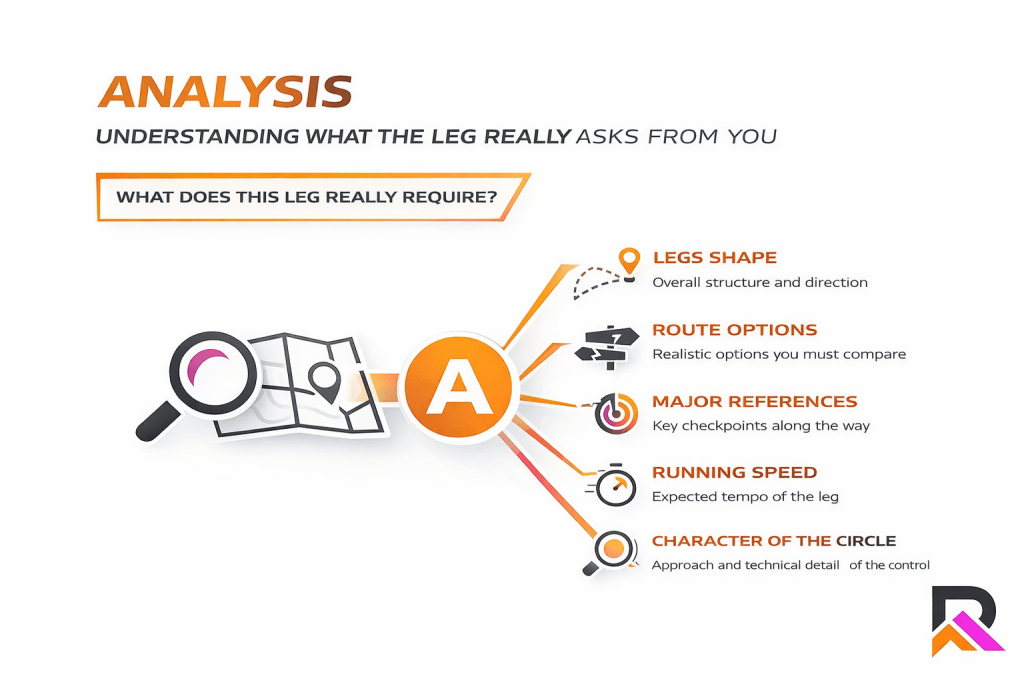
The first phase is Analysis. This is where the athlete must answer the most important question of the leg: What does this leg actually require?
Many mistakes start here, even if they only become visible later. The athlete looks at the map, notices several details, and starts running with partial clarity. He has seen the leg, but he has not really understood its technical character.
Good analysis is not about reading more. It is about reading with priority.
The athlete must quickly identify the nature of the challenge. Is this mainly a route choice leg? A clean exit direction leg? A simplification leg? A control approach leg? A flow leg in fast terrain? A leg where patience matters more than offensiveness?
The better this first reading is, the easier the rest of the process becomes.
Strong analysis usually includes the same core elements: the overall shape of the leg, the realistic route options, the major references, the likely speed of running, and the character of the circle. Not every leg requires the same depth, but every leg requires clarity. The athlete must know what matters most before he commits physically to the leg.
This is also where experienced athletes often separate themselves. It is not always that they see more. Very often, they simply identify the decisive information faster and organise it better.
From a coaching perspective, Analysis must be trained directly. One of the most effective methods is to force the athlete to define the plan before moving. Stop-and-plan drills are simple but powerful. Another is asking the athlete to summarise the leg in one clear sentence before running it. If he cannot describe the leg simply, the analysis is usually still too vague.
A practical rule I often use is this: looking at the map is not the same as analysing the leg.
Many athletes look, but do not interpret. They read, but do not prioritise. Analysis only becomes useful when it produces a clear understanding of how the leg should be solved.
Choice: selecting the right solution, not the most attractive one
Once the athlete understands the leg, he must decide how to solve it. This is the phase where understanding becomes intention.
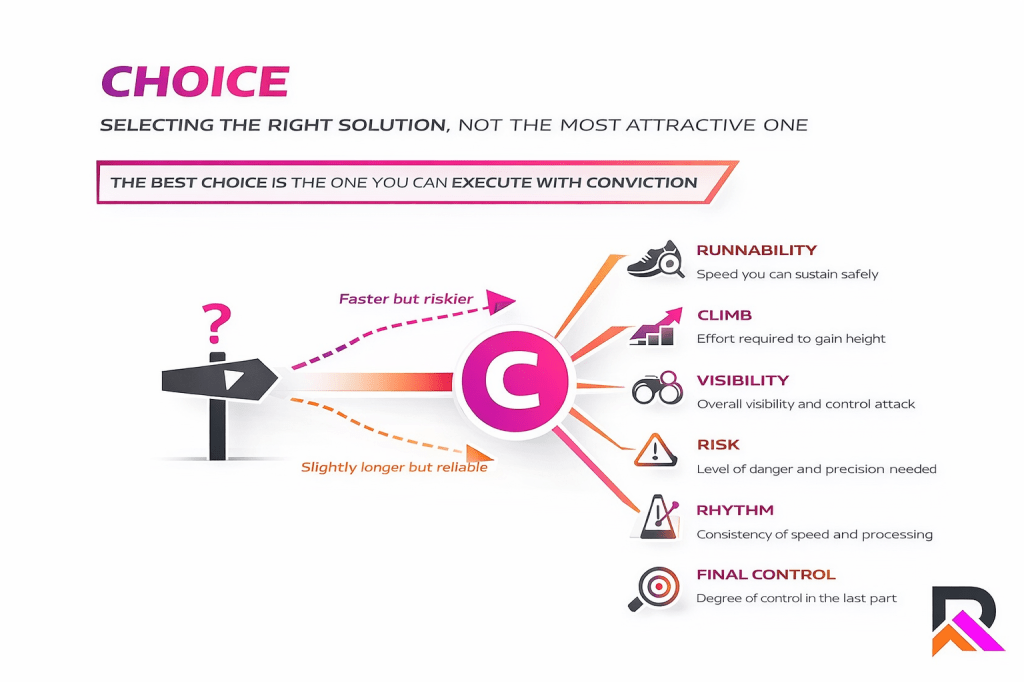
Choice is often reduced to route choice, but in reality, it is broader than that. It also includes the level of risk, the amount of simplification, the speed the athlete can afford, and the degree of control required in the final part of the leg.
A good choice is not simply the shortest or boldest one. It is the solution that best fits the athlete, the terrain, and the race situation. That is a very important distinction.
A route can look excellent on paper and still be the wrong choice in practice if it demands more precision than the athlete can hold at that speed. Another option may be slightly longer, but much more executable and therefore faster in real conditions.
This is where many unnecessary time losses begin. Athletes choose too ambitiously, too emotionally, or too late. Sometimes they are attracted by the most theoretical solution instead of the most reliable one. Sometimes they leave the control without a fully committed decision, and the first part of the leg becomes hesitant. Sometimes they change plans mid-leg without a real reason, simply because the terrain creates doubt.
Good judgment in Choice comes from evaluating more than distance. The athlete must consider runnability, climb, visibility, rhythm, risk, entry quality, and how well the option fits his own strengths in that moment.
This phase can be trained in a very deliberate way. Athletes should be asked not only what they chose, but why. A weak explanation usually reveals a weak decision. It is also useful to take one leg and discuss how the best choice would change depending on context: fresh or tired, alone or in relay traffic, leading or chasing, stable or immediately after a mistake. That kind of work develops judgement, not just hindsight.
A strong practical principle here is simple: the best choice is the one you can execute with conviction. Not blindly. Not comfortably. But with conviction.
Execution: protecting the plan while moving through terrain
Execution is where many technically decent legs are still lost. The athlete has analysed reasonably well and chosen a sensible solution, but fails to carry it out with enough discipline.
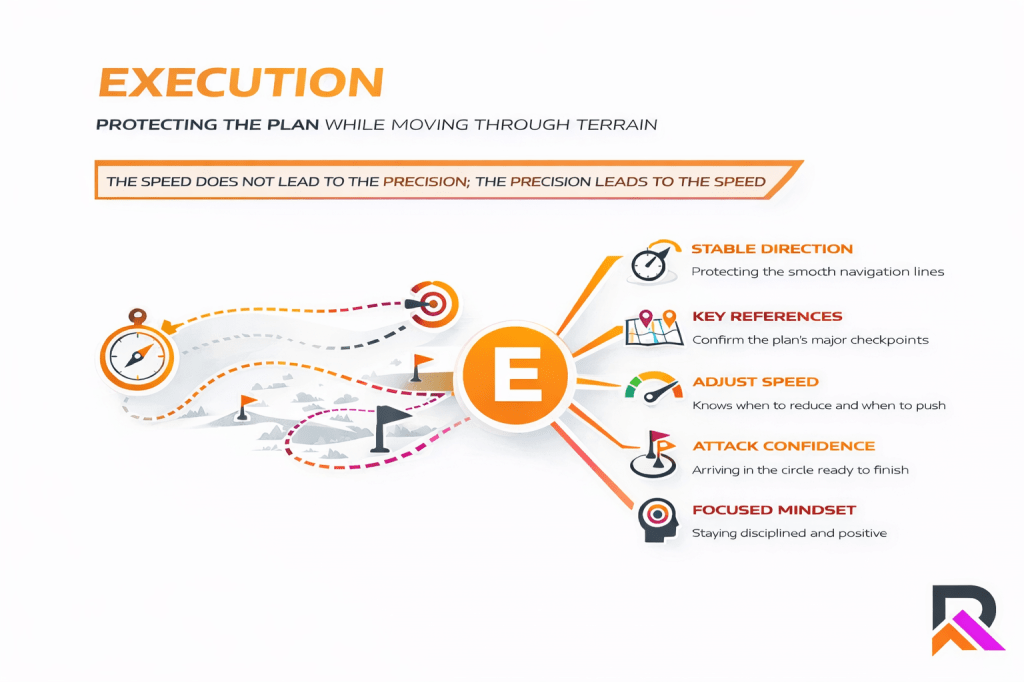
That is why Execution is often the most misunderstood phase. Having a plan does not mean the leg is under control. The plan only matters if it survives while the athlete is moving at race speed.
Good execution means staying connected to both the plan and the map. It means protecting direction, checking the key references, adjusting speed to complexity, and arriving in the circle with enough control to finish cleanly. In other words, Execution is not just running the route. It is continuously keeping the route alive.
Many time losses happen in a very typical way. The athlete starts the leg well, but gradually disconnects. Speed rises above processing capacity. One map check is skipped. Direction starts to drift slightly. The attack point is less clear than it should be. Then the final approach becomes reactive instead of controlled.
This is why strong execution requires discipline, not just courage. The athlete must know when to push, but also when to protect structure. He must be willing to reduce speed in the right places, not because he is passive, but because he understands that technical control is the basis of real speed.
From a training perspective, Execution must be trained in realistic conditions. Not only at low intensity, and not only in ideal terrain. If the goal is to improve racing, the athlete must learn to maintain structure at proper speed, under fatigue, and in sessions where small drops in concentration have visible consequences.
A very useful rule for athletes is this: do not confuse movement with execution. Running hard is not the same as executing well. Good execution is controlled speed, not uncontrolled intensity.
Where the system usually breaks
In competition, Analysis, Choice and Execution are not isolated steps. They are connected, and weakness in one phase quickly affects the next.
Poor analysis usually produces a weak choice. A weak choice makes execution more fragile. Fragile execution then creates insecurity, and that insecurity damages the next analysis. This is how mistakes begin to multiply. The race becomes reactive instead of structured.
Pressure accelerates this process. It reduces time, increases emotional noise, and pushes the athlete toward urgency. He starts to feel that he must keep moving, that slowing down is dangerous, and that he can recover the situation by forcing more speed. Very often, that is exactly when the structure collapses.
One of the most important lessons in high-level orienteering is that pressure does not usually create technical weakness. It reveals it.
That is why technical training should not only improve quality in calm conditions. It should also test whether the system survives when the athlete is under stress. Mass starts, relay simulations, head-to-head exercises, fatigue-based decision-making, and sessions with real consequences all have value because they expose where the process starts to break.
The goal is not to create stress for its own sake. The goal is to teach the athlete to recognise the first signs of technical disorder and restore structure before the mistake grows.
The most practical skill of all: resetting after a mistake
If there is one moment where ACE becomes especially valuable, it is right after an error.
Most mistakes in orienteering are not truly expensive on their own. The major damage usually comes from the response that follows. The athlete becomes emotional, impatient, or rushed. Instead of returning to the process, he tries to recover the lost time immediately. That is often when one small error becomes a chain of poor decisions.
This is why resetting is not only a mental skill. It is a technical one. After a mistake, the athlete must be able to restart the process cleanly. Analyse again. Choose again. Execute again.
Simple in theory, difficult in practice.
Many athletes continue running physically, but mentally they remain at the previous control. They are thinking about the time lost, the mistake made, or the result now slipping away. In that state, they are no longer solving the current leg. They are still fighting the previous one.
The best athletes are not the ones who never lose control. They are the ones who restore it fastest.
That is why we, coaches, should train reset behaviour explicitly. Not only general resilience, but also the technical action of rebuilding the structure after disorder. The athlete should develop a simple routine: relocate, calm the decision, identify the new priority, and commit again. The faster this reset becomes, the smaller the long-term cost of a mistake tends to be.
What coaches should actually do with this model
For coaches, the value of ACE is not that it sounds elegant. The value is that it improves diagnosis, and better diagnosis leads to better training.
Instead of reviewing races with vague comments such as “you rushed” or “you need to focus more,” the coach can identify exactly which part of the process failed and why. That immediately gives direction for future work.
If the Analysis is weak, the athlete needs more work on leg reading, prioritisation, and planning clarity. If the Choice is weak, he needs more work on judgment, route comparison, and matching decisions to context. If the Execution is weak, he needs more realistic technical intensity, better discipline in the circle, and better control of speed versus complexity.
This also helps define the purpose of each session. Too many technical trainings are done with unclear objectives. The athlete simply goes orienteering and hopes improvement will appear. Technical development becomes far more effective when the session targets a specific part of the process.
A useful question before any session is: what exactly inside ACE are we trying to improve today?
That question alone makes training more intentional.
Final thoughts
The ACE system is not a magic formula, and it will not remove mistakes from the sport. Orienteering is too complex for that. But it can provide something extremely valuable: a stable technical framework.
And that matters because high-level orienteering is rarely decided only by moments of brilliance. More often, it is decided by who protects the structure the longest, who keeps making good decisions when the race becomes uncomfortable, and who resets fastest when things begin to drift.
The athlete must train Analysis until he recognises faster what matters. He must train Choice until he selects better solutions for the real situation, not just the ideal one. He must train Execution until good plans survive at race speed. And he must train the reset until one mistake does not become a sequence.
Because in the end, that is what a real technical system should do.
Not just explain performance afterwards.
But make performance more reliable when it matters most.
Discover more from Orienteering Coach
Subscribe to get the latest posts sent to your email.
 Orienteering Coach