
Why orienteers do not only get tired in the legs
There are races where the problem is not obvious from the outside. The athlete is not injured. The shape seems acceptable. The training block has been completed. The warm-up feels normal enough. Nothing suggests that the performance should collapse. But once the race starts, something is missing. The map does not become a clear picture. Decisions arrive half a second too late. The athlete reads, but does not fully understand. They see route choices, but struggle to commit. They leave controls without enough direction, hesitate in places they would normally handle well, and lose confidence after small moments of uncertainty.
Afterwards, the explanation often sounds simple: “I had a bad technical day.”
Sometimes that is true. But in orienteering, technical mistakes are not always caused by poor technique. Very often, they are the visible expression of an invisible load. The athlete does not only carry training stress into the forest. They also carry travel, sleep debt, emotional pressure, cognitive fatigue, nutrition gaps, social expectations and the accumulated demand of previous sessions.
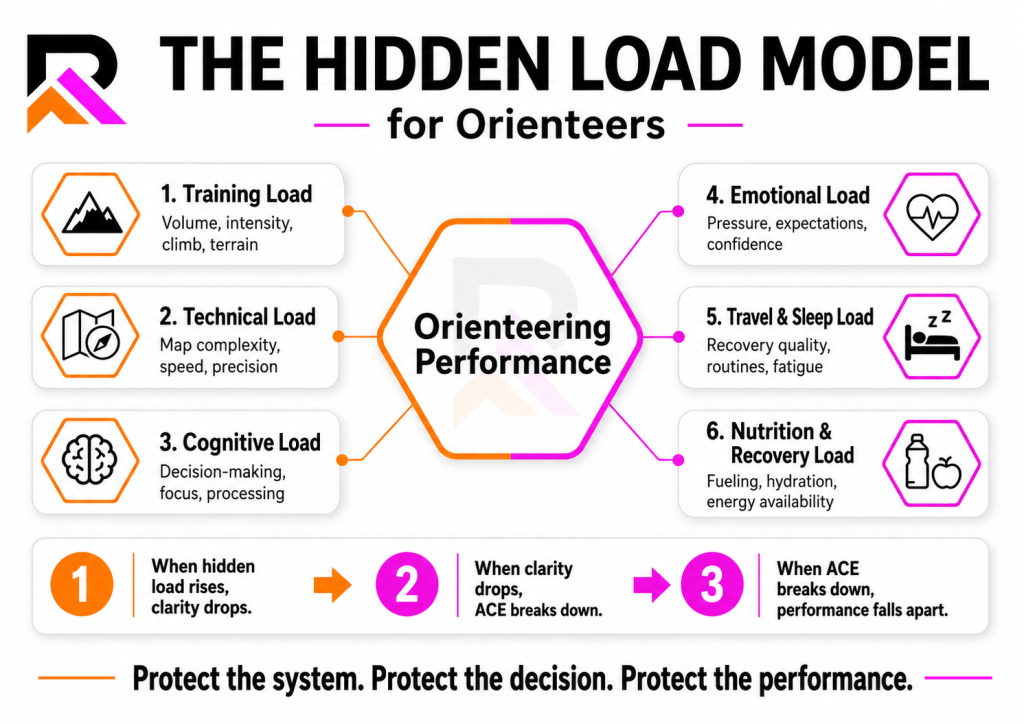
This is the hidden load: the total cost of everything the athlete must absorb before and during performance. It is not always visible in kilometres, heart rate, GPS tracks or training hours. But it often becomes visible in the most decisive place of all: the quality of the next decision.
🧠 From training load to total load
In endurance sport, we are used to measuring what is easy to count. Hours, distance, intensity, climb, intervals, strength sessions and competitions give us useful information. They help us understand the external demand placed on the athlete. But the athlete does not respond only to the training plan. The athlete responds to the full environment around the training plan.
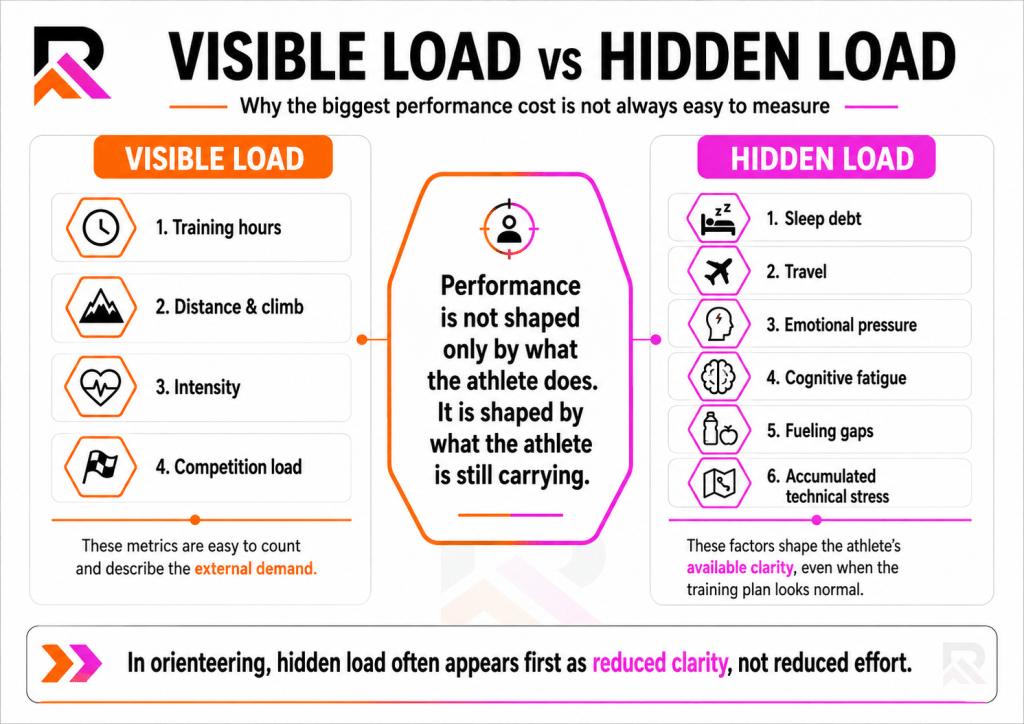
This is where the concept of allostasis becomes useful. Allostasis describes how the body maintains stability by adapting to changing demands. In sport, this means that the athlete is constantly trying to stay functional while absorbing many different stressors at the same time. This idea has beem recently highlighted in elite sport: instead of looking for one isolated problem, we should understand the athlete’s total stressor landscape.
For orienteers, this is especially relevant because performance is never purely physical. The orienteer must run, interpret, choose, execute, regulate emotion and update the plan continuously. A road runner can be tired and still follow the line ahead. An orienteer who loses clarity loses the course. That is why two athletes can complete the same training session and arrive at the next race in very different states. One has absorbed the load. The other is still carrying it. On paper, they may look similar. In the forest, the difference becomes obvious.
🔍 The hidden load appears as loss of clarity
The dangerous thing about hidden load is that it does not always make the athlete feel exhausted. Sometimes the legs are acceptable. Sometimes the pace is still good. Sometimes the athlete can even push hard physically. But the navigation becomes slightly worse. This is one of the most important differences between orienteering and many other endurance sports. In a running race, fatigue usually appears as a visible reduction in speed. In orienteering, fatigue can first appear as a reduction in clarity. The athlete still moves, but the quality of interpretation drops.
They read closer to the body. They stop anticipating. They simplify too little or too much. They choose routes that are safe but slow, or risky without enough control. They lose direction after leaving controls. They become reactive instead of proactive with their navigation. The body may still be moving forward, but the technical process is no longer ahead of the race.
This is why hidden load is so costly. It does not need to create a dramatic collapse. It only needs to make the athlete slightly late, slightly less precise, slightly less stable. In sprint, that can mean missing a barrier or braking before every route choice. In middle distance, it can mean attacking a control without a clear enough picture. In relay, it can mean following the group instead of owning the navigation. At high level, being slightly late is enough to lose control.
⚙️ When hidden load breaks the ACE system
In the RF-COACH framework, technical performance can be understood through the ACE system:
Analysis: understanding the problem.
Choice: selecting the best executable solution.
Execution: carrying out the decision with precision.
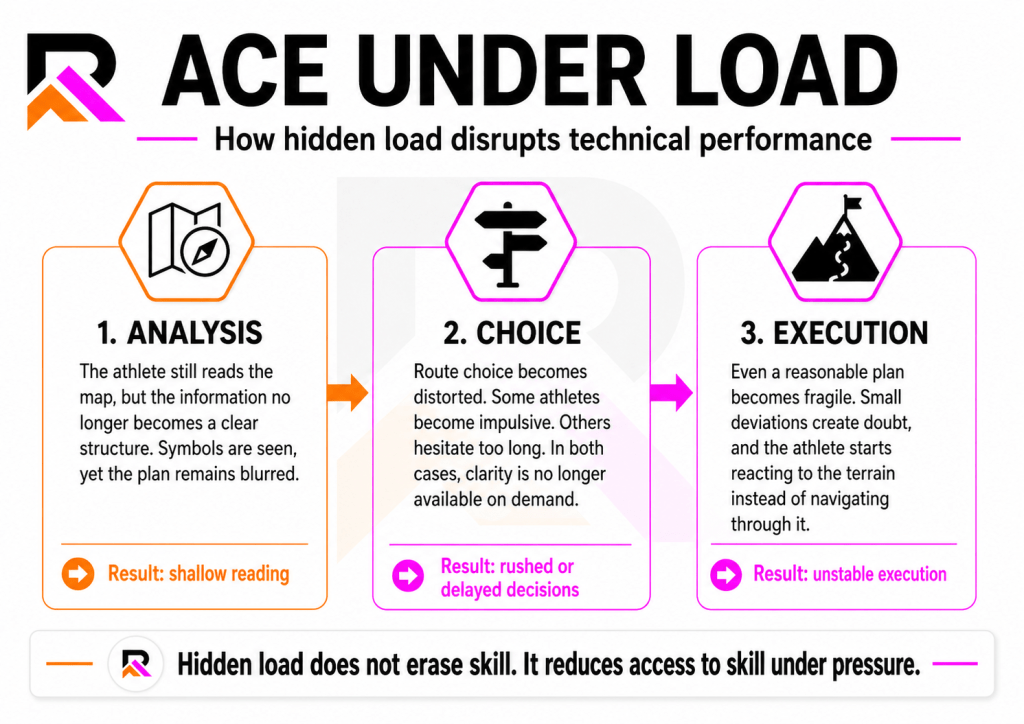
Hidden load does not necessarily destroy ACE in one moment. More often, it weakens each part of the system until the athlete can no longer rely on their normal process.
Analysis becomes shallow
A fresh athlete does not only look at the map. They create structure. They understand the leg, identify the decisive features, recognise the risk and build a mental image of what should happen next. Under hidden load, the athlete may still read the map, but the information does not become useful. Symbols are seen, but not transformed into a plan. The athlete knows they should simplify, but cannot decide what matters most. They look more often, yet understand less. This is the feeling many orienteers describe as “the map is not entering the head”. It is not always a lack of technical knowledge. Sometimes the athlete has the skill, but the system is too loaded to access it efficiently.
Choice becomes distorted
Good route choice is not simply about finding the shortest line. It is about choosing the best option that can be executed at race speed, with the current level of control, confidence and terrain understanding. Hidden load distorts that judgement. Some athletes become impulsive and select the first option they see because they want to escape the decision. Others become hesitant and keep comparing options until the decision itself becomes the time loss. Both reactions come from the same problem: the athlete no longer has enough available clarity to choose cleanly. In sprint, this may appear as overthinking a simple leg or missing the only forbidden barrier that matters. In forest, it may appear as choosing a technically demanding line when the athlete no longer has the precision to execute it.
Execution becomes fragile
Execution is where hidden load becomes most visible. The athlete may have made a reasonable plan, but cannot hold it under pressure. A small deviation creates doubt. A green area feels more threatening than expected. A slope becomes hard to interpret. A compass line drifts because attention is no longer stable. The athlete starts improvising too early. They stop trusting the plan. They react to the terrain instead of navigating through it. This is the key point: hidden load does not make the athlete forget how to orienteer. It makes their normal technical skills less accessible when the pressure rises.
🍌 Fueling the decision-maker
Nutrition is often discussed as a way to fuel muscles. In orienteering, the perspective should be wider. We are not only fueling a runner. We are fueling a decision-maker. This matters most in long technical sessions, training camps, selection races, relays and multi-day competitions. When energy availability is poor, the athlete may not only feel physically flat. They may become less able to concentrate, anticipate, simplify and regulate effort.
The important point is not that every session requires aggressive fueling. An easy run is not the same as a long technical session in demanding terrain. But when a session is long, complex, intense or repeated across several days, fueling becomes part of technical preparation. A poorly fueled athlete may still be able to run. But they may not be able to navigate well.
This is especially relevant in training camps. Athletes often judge the load by the number of sessions, but the true cost is higher. New maps, unfamiliar terrain, social stimulation, travel, pressure to perform, analysis, and repeated concentration all add up. If fueling and recovery do not match that demand, the first thing to drop may be technical quality. In orienteering, nutrition is not only about avoiding empty legs. It is about protecting clear decisions.
🔥 The problem with average intensity
Orienteering often hides its real physiological cost behind average data. A forest session may look moderate when viewed through average heart rate or pace. But the body does not experience the session as an average. It experiences repeated changes: climbs, soft ground, accelerations, hesitation, fallen trees, technical stops, stress reactions and fast sections out of controls. This matters because the energetic demand of orienteering is irregular. Even when the average intensity seems controlled, the session may contain many moments where the athlete relies heavily on carbohydrate availability and rapid decision-making under stress.
This is why overly simple ideas such as “I was only in an easy zone” can be misleading. A technical forest session is not just a run with a map. It is a sequence of physical, cognitive and emotional micro-demands. The average number may look calm, while the total internal cost is much higher.
For coaches, this means that technical sessions should not be evaluated only by duration or intensity. The question is also: how much precision did the session demand, and how much clarity did it consume?
🏙️ Sprint, forest and relay: different loads, same system
Hidden load appears differently depending on the format.
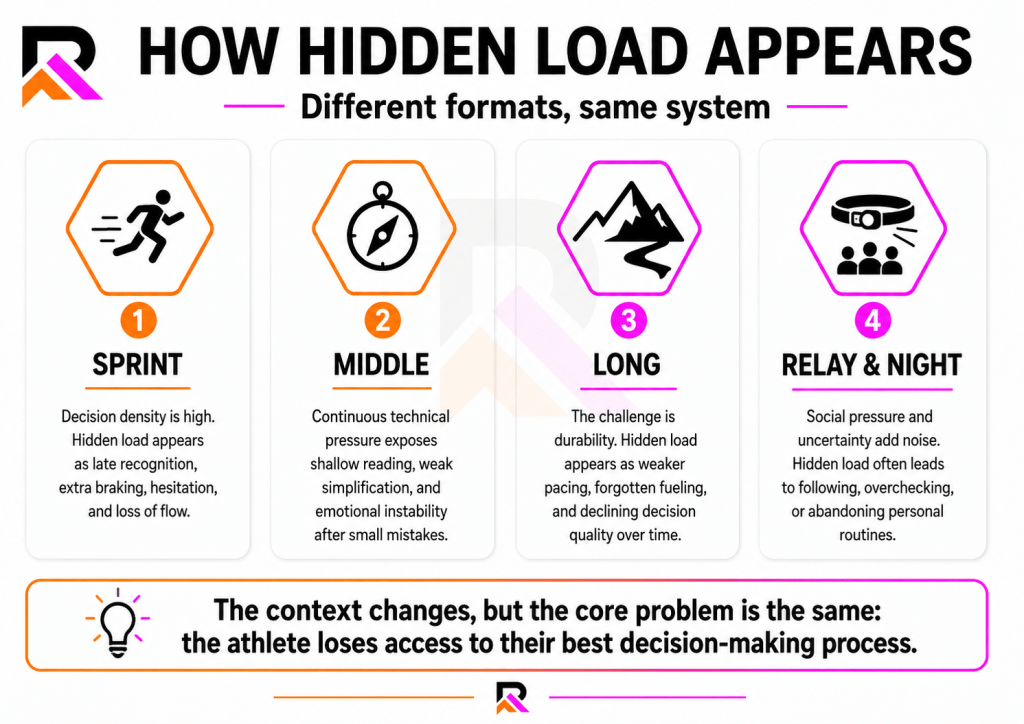
In sprint, the main challenge is decision density. The athlete must process barriers, passages, control descriptions and route choices at high speed. Hidden load often appears as late recognition. The athlete sees the solution, but slightly too late. They brake more, hesitate more, and lose rhythm in places where flow should be automatic.
In middle distance, the demand is continuous technical pressure. There is little time to relax, and the athlete must stay in close contact with the map while interpreting complex terrain. Hidden load often appears as shallow reading, weak simplification and emotional instability after small mistakes.
In long distance, the challenge is durability. The athlete must preserve decision quality over time. Hidden load appears as poor pacing, forgotten fueling, weaker route choice discipline and mistakes after physically demanding sections.
In relay and night orienteering, the load becomes more emotional. Other runners, darkness, responsibility, uncertainty and team pressure create noise around the athlete’s own process. Hidden load often appears as following without control, rushing the first controls, overchecking, or abandoning personal routines.
The contexts are different, but the core problem is the same. The athlete loses access to their best decision-making process.
📋 A better checklist for coaches and athletes
Before judging a bad technical performance, it is worth asking a wider set of questions.
Was the athlete physically loaded, or specifically overloaded by terrain, climb and intensity? Was the technical demand of the previous days high? Were there many complex maps, night sessions or high-speed decision sessions in a short period? Was the athlete sleeping well, eating enough and recovering between sessions? Was there travel, school, work, selection pressure or emotional stress in the background?
And perhaps most importantly: was the athlete failing because they lacked skill, or because they lacked available clarity?
That distinction matters. If the issue is skill, the solution may be better technical training. If the issue is hidden load, the solution may be different: simplify the next session, restore rhythm, reduce noise, fuel better, sleep more, or create enough space for the athlete to regain access to what they already know.
Coaching is not only about adding better sessions. It is also about understanding when the athlete is ready to absorb them.
🧩 Protect clarity, not comfort
The goal is not to avoid load. Orienteering development requires demanding terrain, complex decisions, pressure, mistakes and fatigue. Athletes need to be exposed to difficulty if they want to perform under difficulty.
But difficulty must have a purpose.
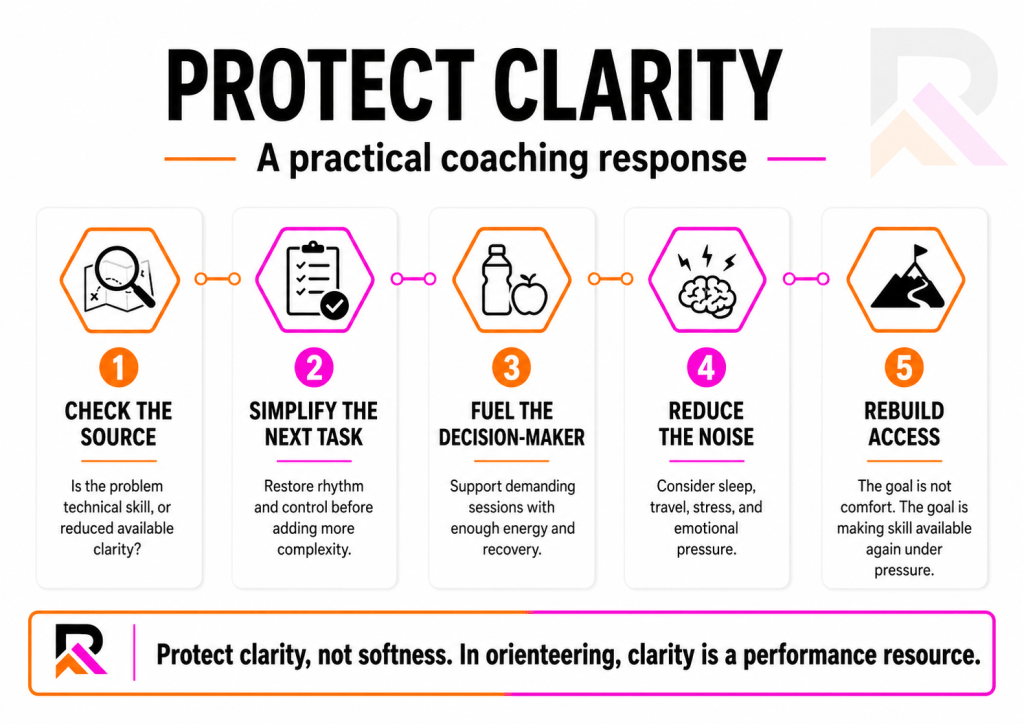
There is a big difference between a session that develops resilience and a session that only confirms exhaustion. There is a difference between technical pressure that teaches the athlete to stay calm and technical pressure that simply breaks their process. There is a difference between racing under controlled stress and repeatedly training in a state where no learning is possible.
Coaches should know when to increase complexity and when to remove it. They should know when the athlete needs a hard simulation and when they need a clean, confidence-building session. They must understand that clarity is not softness. It is a performance resource. In orienteering, protecting clarity does not mean making training easy. It means making training effective.
🏁 Final Thoughts
Orienteering is often described as a combination of physical, technical and mental skills. That description is correct, but incomplete. In competition, these skills do not operate separately. They merge into one system that must remain clear while under pressure.
Hidden load matters because it attacks that system before it always attacks the legs. It makes analysis shallower, choice less precise and execution more fragile. The athlete may still be fit, motivated and committed, but the quality of the next decision begins to decline.
That is why coaches and athletes should look beyond visible training load. The real question is not only how much work has been done. The deeper question is whether the athlete has enough available capacity to make good decisions at speed. In orienteering, performance does not come only from stronger legs or better maps in training. It comes from a clearer system.
Protect the system.
Protect the decision.
Protect the performance.
Enjoyed this article? 🧭
Share it with someone who loves orienteering, training and performance. 🚀
And if there is a topic you would like to see next on RF-COACH, feel free to contact me. 💬
Discover more from RF-COACH
Subscribe to get the latest posts sent to your email.


One thought on “Unleashing Your Potential: 🪫 The Hidden Load in Orienteering Performance”