
The JWOC 2026 🇸🇪 will bring the best young orienteers in the world to Karlskrona, Sweden, for a championship week that has all the ingredients of a memorable edition. A historic city by the Baltic Sea, fast sprint terrain in the heart of Trossö, flat Scandinavian forests, strong live coverage, and a full programme where every discipline will ask a slightly different question.
There is something really cool about having a Junior World Championships in a place like Karlskrona. The city is not just a backdrop. It is part of the story. The naval history, the archipelago feeling, the streets, the open squares, the waterfront and the surrounding forests create a setting that feels both very Swedish and very championship-like. For spectators, it should be a fantastic week to follow. For athletes, it will be one of those rare opportunities where the environment itself adds extra energy to the competition.

But behind the atmosphere, JWOC is still JWOC.
For many runners, this is the last big step before senior elite orienteering. It is not only about being talented, fit or technically skilled. It is about showing that those skills can survive the pressure of international racing: quarantine, GPS tracking, live broadcast, team expectations, medal chances, mistakes from previous days, and the emotional load of representing your country on a world stage. That is why Karlskrona will be interesting. The terrain may not look extreme at first glance. The sprint will be fast and readable in many places. The forest will be flat, with a 2.5 m contour interval and generally good runnability. But easy-looking terrain can be dangerous when the speed rises. The challenge may not always be visible in the form of steep hills, massive route choices or brutal physical obstacles. It may appear in smaller, more subtle ways: a closed passage, a late barrier, a compass line drifting slightly, a vegetation change not understood early enough, or a control approach taken without a clear final picture.
In that sense, JWOC 2026 may reward something very close to elite maturity.
📅 A full championship week
The programme is beautifully balanced. The week opens with the Sprint on Monday 29 June, followed by the Sprint Relay on Tuesday. Then comes the Long Distance on Wednesday, before a rest and model day on Thursday. The forest block finishes with the Middle Distance on Friday and the Relay on Saturday.
That sequence matters. Two sprint days will immediately put athletes under high cognitive pressure. The opening races will require fast decisions, clean execution and the ability to handle artificial restrictions without losing rhythm. Then, almost without time to reset emotionally, the championship moves into the forest, where the demands become less urban but no less precise. The Long Distance in Augerum should be a proper test of endurance, route choice and terrain management. The Middle and Relay in Bussevik will likely be faster, flatter and more technical in a different way, with pine, oak and beech forest, open rock surfaces, few tracks and high runnability in many sections. This is a combination that can produce exciting racing: high speed, limited climb, but constant demand for direction, map contact and control.
🚧 The sprint: readable does not mean simple
The Sprint and Sprint Relay will take place in Trossö, the historic centre of Karlskrona. On paper, the description sounds like a typical Scandinavian sprint: normal to slightly complex city structure, flat terrain, hard surfaces, some parks, grass areas, hedges, vegetation and artificial barriers.
This may not be as extreme as what we saw in Skara and Linköping during World Cup #2, where the temporary sprint layer became very aggressive in places. Karlskrona may have a slightly cleaner and more classical Scandinavian sprint identity. But the underlying challenge is similar. The athlete will see a city that looks runnable. Streets may appear logical. The map may feel easier to interpret than a dense Mediterranean old town.
At junior level, the sprint challenge is often not only technical. It is emotional. The map may be readable, the city may look logical, and the route choices may appear quickly, but under JWOC pressure even a small hesitation can grow into a mistake. Artificial barriers, forbidden areas and narrow legal passages will still shape the race, but the decisive factor may be how calmly each athlete processes that information while running at full speed.
In Karlskrona, the key will not be to solve every leg like a puzzle from a chair. It will be to stay composed while the race is moving. See the barriers. Understand the passages. Know the entry and exit. Then run with conviction. At JWOC speed, confidence is not about guessing; it is about having just enough information to push hard without losing control.
🌲 The forest: when flat terrain demands discipline
The forest races will bring a completely different kind of pressure. The Long Distance uses a 1:15000 map with 2.5 m contours in terrain that can be described as flat to moderately hilly, with varied vegetation from fast beech forest to slower coniferous areas. There are some paths and tracks, and some slopes with more stones, but the overall impression is not of a brutal physical long distance. It looks more like a race where runnability, route choice, vegetation interpretation and control of speed will become decisive.
The Middle and Relay terrain in Bussevik appears even flatter. Pine, oak and beech forest, areas of open rock, high runnability when not reduced by undergrowth, few tracks and few stones apart from traces of old stone pits. On paper, this can sound fast. In reality, it may become technically demanding precisely because it is fast.
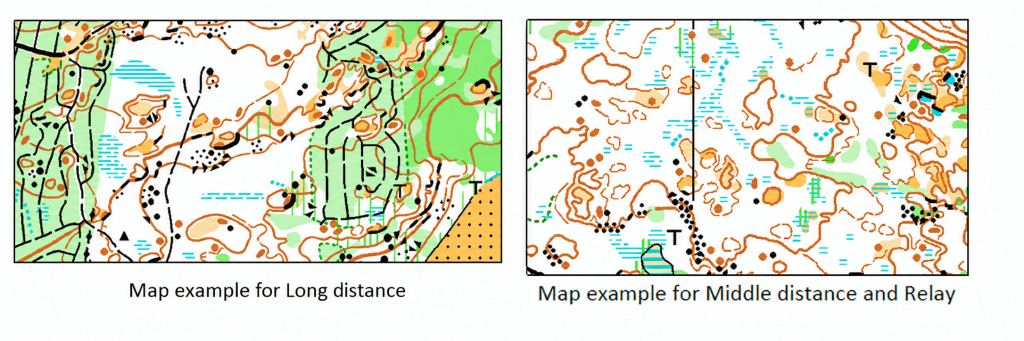
Flat terrain with a 2.5 m contour interval does not give the athlete many big shapes to rely on. There may not be a clear hill, a strong valley or a large contour feature constantly organising the navigation. Instead, runners may need to build their structure from more subtle information: direction, vegetation, open rock, small contour shapes, distance feeling, compass control and the relationship between features that do not always stand out dramatically.
That is why mastering the compass will probably be one of the most important skills of JWOC 2026. Not compass as a passive safety tool. Compass as an active way of creating direction, rhythm and confidence. In fast forest, a small drift can be very expensive. The athlete may still be running well, still reading often, still feeling in control, but after 150 or 200 metres the line has shifted just enough to make the terrain picture confusing. In flat terrain, that confusion can arrive late. And when it arrives late, it often arrives with speed.
“The best runners will use the compass proactively. They will leave controls with direction. They will simplify the leg before the terrain becomes vague. They will know which features should appear on the line, which ones are only background noise, and where they need to slow down for precision. They will not try to read everything. They will read the right things early enough.“
This is a key difference between junior and elite orienteering. Juniors often have the speed and the technical knowledge, but the best senior athletes have a more stable process under pressure. They do not only react to what they see. They anticipate what they should see next. They are already preparing the next control approach before the terrain forces them to do it.
📈 The JWOC step
JWOC is special because it sits at the border between development and elite performance. It is still a junior championship, but the demands are already close to senior racing. The athletes are young, but the event is professional. The courses are serious. The margins are small. The emotional load is real. For some athletes, JWOC will be the biggest race they have ever run. For others, it may be the first time they realise that they are ready for the next level. That is part of the beauty of the event. It is not only a place where medals are won. It is a place where future elite runners start to recognise themselves.
Karlskrona should offer a very good test for that transition. The sprint will ask for fast interpretation and control of artificial restrictions. The long distance will ask for patience, route choice and endurance. The middle and relay will ask for compass, flow and precision at speed. Across the whole week, athletes will need to manage not only the map, but also the rhythm of the championship.
That is often where JWOC is won and lost.
A bad sprint does not have to destroy the long distance. A strong long distance does not guarantee a clean middle. A relay leg is not only another forest race; it is a race where other teams, pressure and emotion can distort the technical process. The best juniors will be those who can reset, adapt and return to their own process each day.
🧠 Simulated Leg for the Long Distance
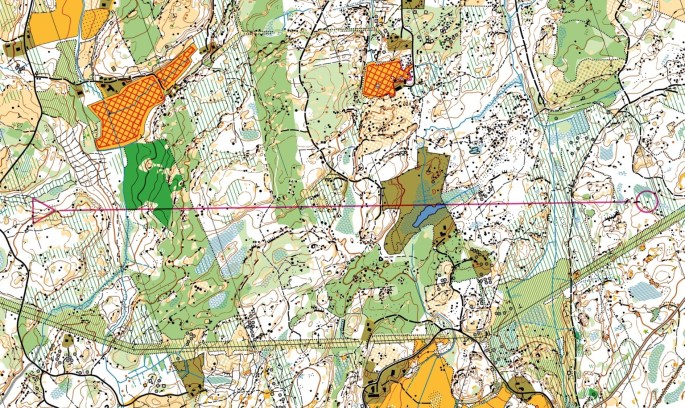
As part of this preview, I have prepared a simulated leg inspired by the type of decision-making that may define JWOC 2026 in Karlskrona. The goal is not to predict the exact courses. That is impossible, and it would also miss the point. The goal is to train the process: how to look at a leg, identify the decisive information, choose an executable solution and commit under pressure.
➡️ Your task:
Take a close look at the map below. Draw your route and imagine seeing this leg during the JWOC long distance, stress and limited time to decide. Where can you run fast? Where do you need precision? And how will you attack the control without losing map contact?
SPOILER ALERT!!!
If you haven’t drawn your route yet, do not keep scrolling down!!!
The analysis of the routes is posted just below!!!

After presenting this simulated long-distance leg from Karlskrona, it is time to look at the main alternatives. I identified six possible routes:
- Route A: 2910 m, +25 m
- Route B: 2410 m, +35 m
- Route C: 2290 m, +35 m
- Route D: 2270 m, +30 m
- Route E: 2390 m, +40 m
- Route F: 3080 m, +30 m
The straight-line distance is 2130 m. The climb is almost irrelevant here, with all options sitting within a very small range. That means the decision should mainly be based on distance, runnability, technical control and the quality of the line through the forest.
Routes A and F are the widest alternatives. They offer open and relatively simple running, but in this terrain they are difficult to justify. Route A adds 780 m compared with the straight line, while Route F adds 950 m. That is a lot of extra distance in a fast and flat forest. Unless the direct alternatives were extremely blocked or very slow, these routes would probably lose too much time. For me, they are not realistic options for a good split.
Route E is more interesting on paper because it is not as long as A or F, but it still has some clear weaknesses. It requires a large percentage of forest execution without much support from paths, and it does not use enough clean white forest to compensate for that risk. The route may look possible, but it does not offer the best balance between speed and security. In a long distance, this kind of route can easily become expensive if the athlete loses rhythm or gets trapped in slower vegetation.
That leaves Routes B, C and D as the real contenders.
Route D is the shortest option, only 140 m longer than the straight line. That is attractive, and for a very confident athlete it can definitely be competitive. However, it also demands more technical control throughout the leg. There is less path support, more continuous forest navigation and more responsibility on the athlete to keep direction and read the vegetation correctly. In isolation, it may be the shortest route, but in the context of a long-distance race, the question is whether it gives enough speed and stability to be the best overall choice.
Route B and Route C share the same second half. The difference comes in the first part of the leg, where the athlete must decide how to deal with the first difficult patch of forest.
At first glance, Route B can feel like the cleaner option because it uses the field as support. That gives a nice visual structure and may reduce some of the technical stress early in the leg. But the price is distance. Route B is 2410 m, around 120 m longer than Route C, and it also passes through an area that is worse in terms of visibility or runnability before reaching the path. It is a solid route, and it can be fast if executed well, but it may not offer enough benefit to justify the extra metres.
Route C is my preferred option. It stays closer to the straight line, avoids the worst parts of the first green area, connects reasonably well with the path system, and then uses the same strong second half as Route B. It is not a “safe around” route, but it is not an uncontrolled straight route either. It gives a good compromise: enough directness to save distance, enough structure to run with confidence, and enough clean running in the second half to maintain high speed. The key with Route C is execution. You cannot simply point the compass and hope. The athlete needs to keep the head high, identify the best lines through the vegetation, use the white patches well, and avoid being dragged into the slowest parts of the green. If executed with confidence, this route gives the best chance to combine speed, control and distance efficiency.
My ranking for split victory would be:
C, B, D, E, A, F
However, the differences between B, C and D may not be decisive if the execution is good. This is one of the most important lessons from this leg. In this kind of fast Swedish forest, the best route choice may only create a small advantage. The bigger differences can come from avoiding the worst vegetation, keeping direction, maintaining rhythm and not hesitating in the transitions between forest, paths and open patches.
The main principle is clear: stay close to the magenta line when possible, but do not be naive. The straightest route is only fast if the forest allows you to run. The widest route is only worth it if the surface is clearly faster. The best solution is usually somewhere in between: a route with good progression, limited fighting, clear direction and enough confidence to execute it offensively.
Expert Input
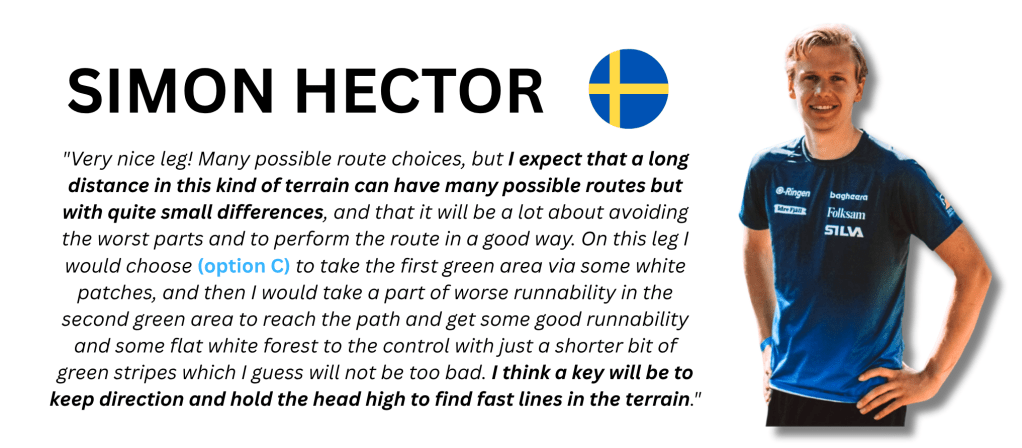
To support the analysis, we also asked Simon Hector for his view on the leg. Simon is one of the absolute top-level athletes in the world right now, and he has strong knowledge and experience in this kind of terrain. We are very grateful for his feedback.
Final Thoughts
JWOC 2026 in Karlskrona has the potential to be a great championship: beautiful, fast, technical, spectator-friendly and demanding in a way that may not always be obvious from the outside.
The sprint will reward athletes who can handle a Scandinavian urban puzzle without becoming careless. The forest will reward those who can run fast in flat terrain without losing direction. Across the whole week, the best performances will probably come from runners who combine speed with maturity: athletes who know when to push, when to simplify, when to trust the compass and when to protect the control approach.
That is what makes this JWOC so exciting.
It will not only show who is the strongest junior right now. It may also show who is ready to take the next step towards world elite orienteering.
Enjoyed this article? 🧭
Share it with someone who loves orienteering, training and performance. 🚀
And if there is a topic you would like to see next on RF-COACH, feel free to contact me
Discover more from RF-COACH
Subscribe to get the latest posts sent to your email.


Is it possible to watch it on TV, which channel?
LikeLike
Yes, you can watch via Langrenn.com if you are in Norway or buying a ticket at IOF-TV! Worth to watch it!
LikeLike