
At the end of May, the 2026 Orienteering World Cup continues in Sweden, with Skara and Lidköping hosting the second round of the season from 28 to 31 May. After the opening sprint weekend in Locarno and Ascona, the World Cup now moves into another pure sprint block: Knock-Out Sprint in Lidköping, followed by Individual Sprint and Sprint Relay in Skara. The format is familiar. The challenge will not be.
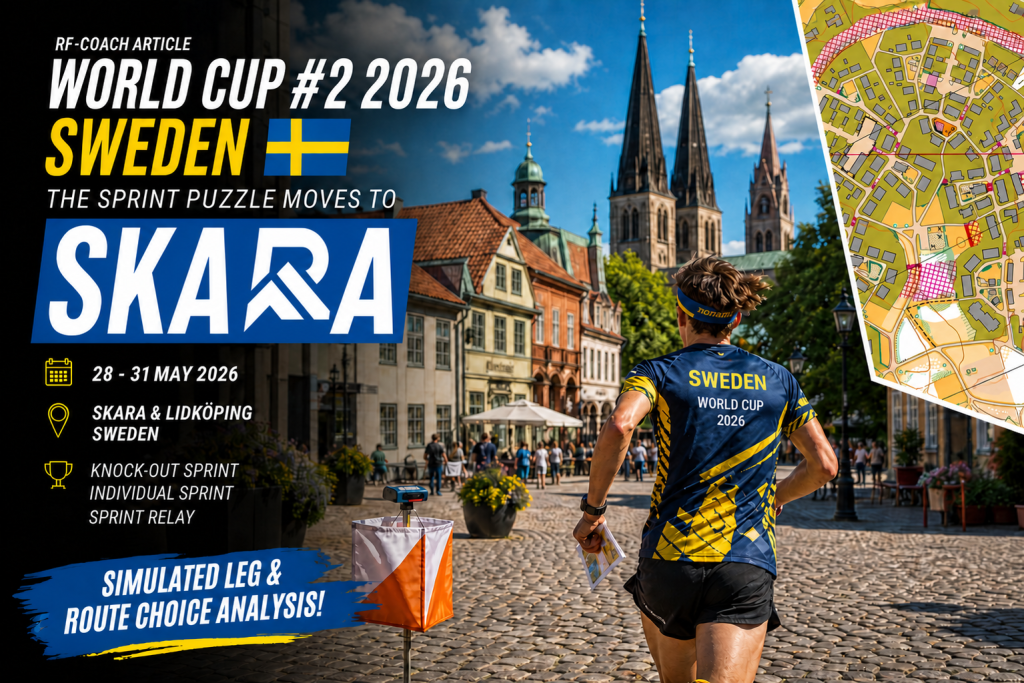
Locarno offered a very visible sprint identity. The city immediately suggested rhythm changes, old town passages, open urban spaces, slope, route choice and technical pressure. Skara and Lidköping may ask a more subtle question. These are compact Swedish urban environments, where the sprint problem may not come from spectacular complexity, but from how quickly the athlete can understand a course that has been deliberately made harder to read at speed.
That is the essence of modern sprint orienteering.
The athlete is not just choosing a route. The athlete is choosing a route while moving, while breathing hard, while leaving a control, while already needing to prepare the next decision. The real difficulty is not only to find a good option. It is to recognise the fastest executable option early enough, trust it enough and avoid being caught by a trap that was visible on the map, but not processed in time.
In Skara and Lidköping, that may be the decisive theme: speed against interpretation.
🇨🇭 Summary of the Stage #1
Round 1 already gave us a strong reminder of what elite sprint orienteering has become. In Locarno, the races were not only about running speed or choosing the obvious line. They were about handling pressure, interpreting details at full intensity and staying technically clean in situations where one small misread, one forbidden feature, one hesitation or one uncontrolled moment could change everything. Hanna Lundberg (SWE) and Tino Polsini (SUI) opened the season with victories in the Individual Sprint, Norway dominated the Sprint Relay, and the Knock-Out Sprint finished with exactly the kind of drama that defines this format: Hedvig Valbjørn Gydesen (DEN) took a surprise win in the women’s race, while Kasper Fosser (NOR) beat Tuomas Heikkilä by only a few centimetres in the men’s final.
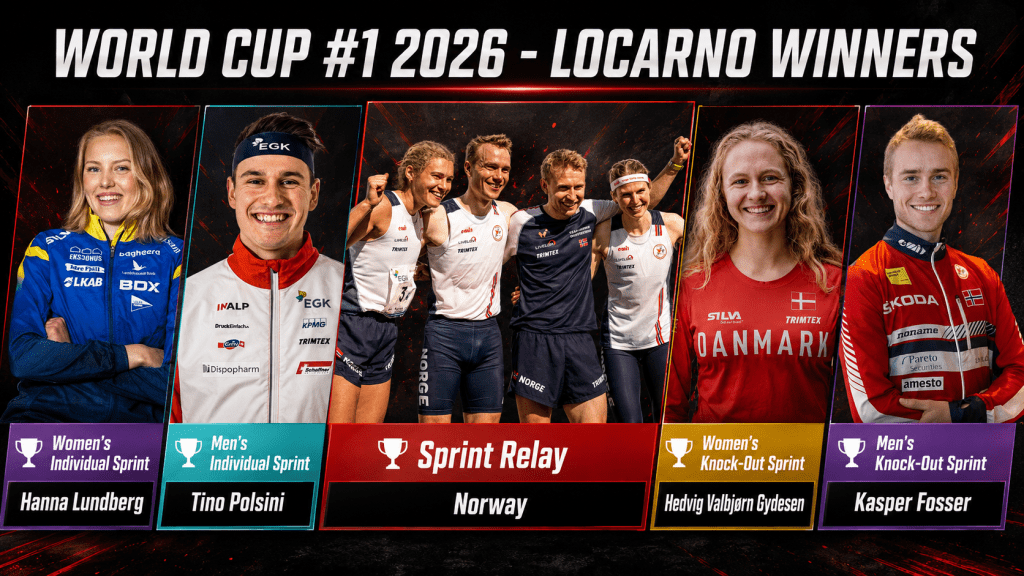
But perhaps the most interesting lesson from Locarno was not only who won. It was how fragile success can be in modern sprint. Fosser’s Knock-Out victory was confirmed only after jury discussions, following TV images showing him crossing an area marked as impassable on the map. He was eventually allowed to keep the win, but the situation was a perfect example of the razor-thin line athletes walk in sprint: the fastest decision is worthless if it takes you through a detail you have not fully understood. SVT’s expert Mats Troeng was critical of the decision, while Finnish coach Thierry Gueorgiou acknowledged that many would expect a disqualification, even if he accepted the final outcome from a fair-play perspective. My opinion? You should only disqualify an athlete when everything on the map and on the terrain is clear and in accordance with the rules (it was not).
🏙️ The Terrain: Skara & Lidköping in Focus
Skara and Lidköping should offer a very different sprint character from what we saw in Switzerland. Not necessarily more spectacular, and probably not as immediately dramatic as the narrow streets, stairs, slopes and irregular old-town structure that we often associate with southern European sprint terrain. Locarno already showed some of that flavour in the opening World Cup round, and Genoa, with its dense urban fabric and complex historical layers, is likely to push that southern European identity even further at WOC this summer.
Sweden may ask a different question.
In many Scandinavian towns, the urban structure tends to be more open, more ordered and easier to understand at first glance. Streets can feel wider, residential areas more regular, green spaces more integrated, and the overall geometry less chaotic than in older Mediterranean city centres. For a sprint athlete, that changes the nature of the challenge. The difficulty may not come from fighting through a maze of alleys and stairways, but from maintaining high speed in terrain that looks readable while still detecting the small restrictions that define the course.
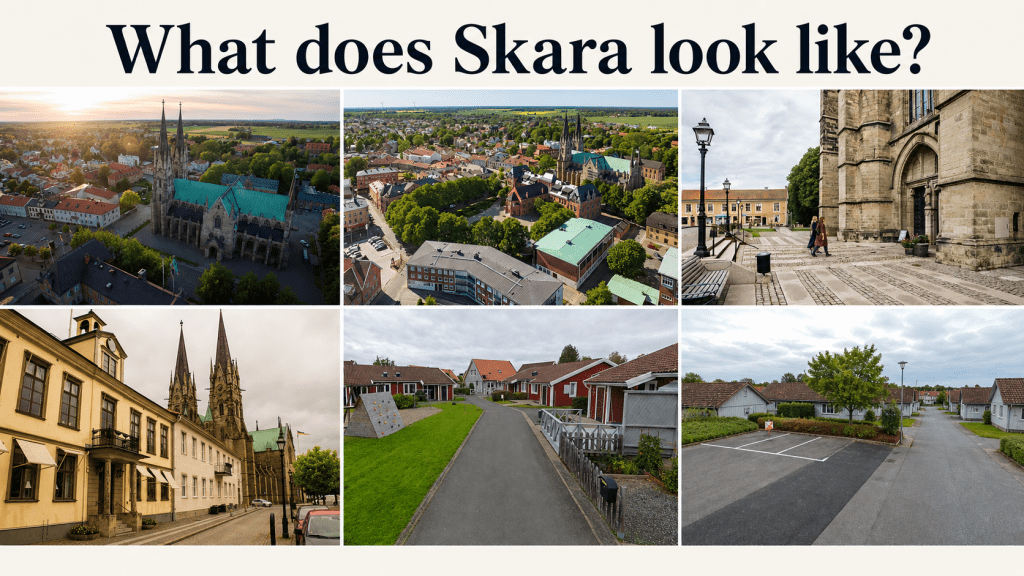
This is where Skara and Lidköping can become very effective for elite sprint. Compact town centres, residential blocks, school areas, small green spaces, park sections, passages and historical streets can create a rhythm where the athlete is constantly moving between fast running and precise interpretation. The map may look logical. The city may seem to offer clear lines. The first route option may appear almost too quickly. But in sprint orienteering, an easy first impression can be dangerous.
The course-setter is not simply using the city. The course-setter is adding a temporary tactical layer on top of it. Extra barriers, forbidden areas and artificial closures can change the natural logic of the terrain. A direct passage disappears. A simple street line becomes interrupted. A residential block that looked straightforward suddenly requires a late turn, a wider approach or a different control entry. The problem is not artificial difficulty for its own sake. When done well, these elements force exactly the kind of pressure sprint should create: read fast, but not superficially; simplify, but not ignore the decisive restriction; commit, but not before the route is truly understood.
That balance is one of the hardest skills in high-level sprint.
In southern European terrain, the cognitive load is often visible from the beginning. The athlete expects density, irregularity, stairs, narrow alleys and frequent direction changes. The brain enters the race prepared for chaos. In a Scandinavian setting, the cognitive load can be more subtle. The athlete may feel that the terrain allows faster, cleaner running, and that can encourage earlier commitment. But if the course has been carefully planned, the decisive information may be hidden inside a map that looks simpler than it really is.
That is a different kind of stress.
At elite level, most athletes can identify route options. The difference is how quickly they understand which details actually define those options. A barrier placed in the right position can change the whole leg. A small forbidden area can make an apparently good route collapse. A narrow opening can decide whether an option is smooth or risky. A control placed just after a fast section can punish the athlete who has been running faster than they have been reading.
These details are easy to see when standing still. They are much harder to process when the body is already accelerating away from the control. That is why Skara and Lidköping are so interesting. The race may not be decided by one spectacular mistake, but by a sequence of small moments where the best athletes understand the course-setter’s intention a little earlier than the others. In sprint, those seconds are not just time. They are control.
🧠 Simulated Leg from World Cup #2 2026
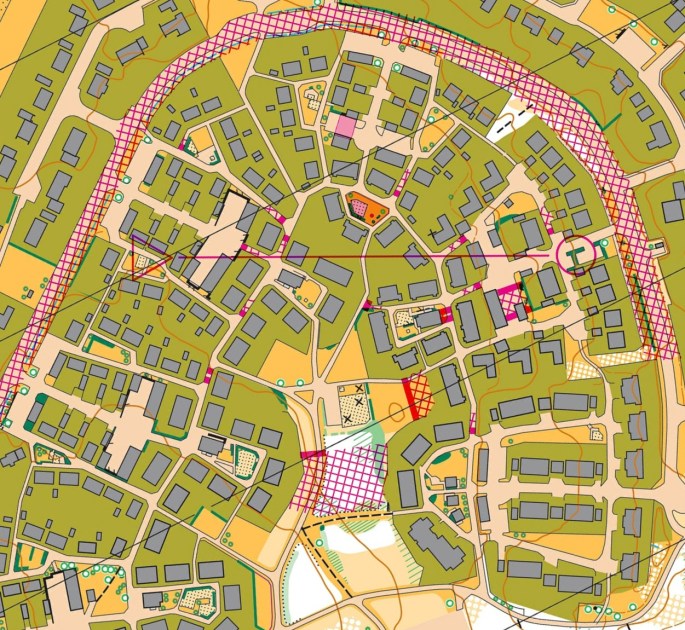
As part of the preparation for this second World Cup round, I have created a simulated sprint leg inspired by the type of challenge athletes may face in Skara. The leg is built around a very current sprint problem: several viable route options, extra barriers, and a layout where the fastest solution is difficult to identify instantly at high speed. The real difficulty is not simply finding a possible route. Most elite athletes will see several. The challenge is to do it quickly, under fatigue, stress and pressure, and to decide within a few seconds which option is good enough to execute, which one is clearly slower, and which one hides a trap that could cost serious time.
That is where sprint becomes brutal. A mistake often starts before anything visible happens. It starts in the decision process, when one restriction is not understood, one blocked passage is underestimated, or one control entry looks easier than it really is. The athlete commits to a route that felt fast, but the map had already shown the problem. The information was there. It just was not processed in time. This type of leg is valuable because it forces us to analyse sprint route choice as it really happens: not as a calm post-race comparison, but as a race-speed decision. The key is finding the right balance between analysis time and execution risk. Spending too long choosing the perfect route can cost more than the route choice itself. But committing too early can send you into a trap.
At World Cup speed, the best decision is often not the perfect one. It is the one you can recognise, trust and execute before uncertainty starts costing time.
➡️ Your task:
Take a close look at the map below. Draw your route. But do not analyse it as if you had unlimited time. Try to imagine seeing this leg in a World Cup sprint, leaving the previous control at high speed, with only a few seconds to detect the trap, choose the line and commit.
💡 Suggestion: Even if you are looking at it comfortably seated on the sofa, I challenge you to time how long it takes you to make a decision from the very first glance at the leg. How many seconds do you need? Was it a good decision? Was the time invested in making it actually worth the potential benefit of finding a faster route?
READY?… 3, 2, 1, GO!
SPOILER ALERT!!!
If you haven’t drawn your route yet, do not keep scrolling down!!!
The analysis of the routes is posted just below!!!
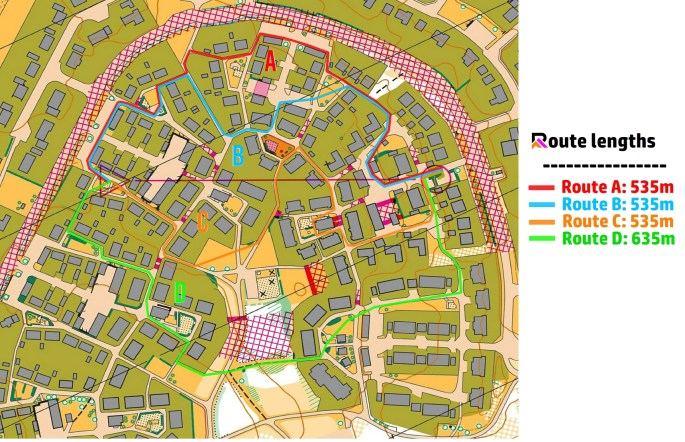
After presenting this simulated leg inspired by Skara and Lidköping, it is time to move into the strategic analysis. I identified four main options:
Route A: 535 m
Route B: 535 m
Route C: 535 m
Route D: 635 m
If you chose A, B or C, congratulations. You found one of the best solutions. But the real question is: how long did it take you to decide?
Routes A, B and C have the same measured distance, so if they are executed well, the split should be very similar. A and B may perhaps offer a slightly smoother rhythm with fewer sharp turns, but none of the three is clearly superior enough to justify spending too much time searching for the “perfect” option. That is the key lesson of this leg. In this type of sprint route choice, the priority is to identify a viable route quickly, understand the whole line, check that no extra barrier breaks your plan, and commit. The difficulty is not only choosing well, but choosing fast enough without falling into a trap that was visible on the map but not processed in time.
Route D is different. At 635 m, it is around 100 m longer, which is simply too much unless the shorter options are executed very poorly. It may look safer or easier to understand, but the price is probably too high.
The biggest danger is starting the leg with only a partial plan. With several artificial barriers, that can quickly turn execution into improvisation. And in sprint, improvisation usually means hesitation, extra distance and loss of control for the next decision.
So, in my opinion, A, B and C are all strong choices. The best strategy is not to overanalyse the small differences between them, but to find one of them, connect the full route, and execute with confidence.
In a leg like this, the question is not only: Did you choose the right route?
It is: Did you choose a good route fast enough to make it worth choosing?
Final Thoughts
At this level, sprint orienteering is not only about finding routes. It is about managing the full decision process under pressure: when to analyse, when to simplify, when to commit, and when to trust that a good solution executed cleanly is better than a perfect solution found too late. Skara and Lidköping may reward exactly that kind of maturity. The terrain may look more readable than some of the southern European sprint areas, but that can make the challenge even more dangerous. When the city looks logical, athletes tend to release speed earlier. The best ones will be those who can run fast without letting the map become secondary.
A few final thoughts before World Cup #2:
- Do not chase perfection for too long. In this type of sprint, the options may be almost equal. The time spent trying to identify the absolute best one can quickly become more expensive than the difference between them.
- Build the whole route before committing. With extra barriers, a route that looks good in the first half can collapse later. Make sure the line connects all the way to the control, not only out of the control.
- Respect the invisible traps. The most dangerous mistakes are often not spectacular. They come from a passage assumed to be open, a barrier processed too late, or an entry that looked simple at first glance.
- Protect your next decision. A route choice is not finished when you start running it. Choose and execute in a way that gives you time to read ahead, because the next leg may punish the mental cost of this one.
- Stay calm when the terrain looks easy. That may be the biggest lesson for Skara and Lidköping. Speed is necessary, but control decides how useful that speed becomes.
Best of luck to all athletes competing in Sweden. Trust your process, stay sharp with the details, and enjoy what should be a very interesting second chapter of the 2026 World Cup.
Enjoyed this article? 🧭
Share it with someone who loves orienteering, training and performance. 🚀
And if there is a topic you would like to see next on RF-COACH, feel free to contact me. 💬
Discover more from RF-COACH
Subscribe to get the latest posts sent to your email.

